Industrial Sieve Screen: Complete Guide for Efficient Material Screening
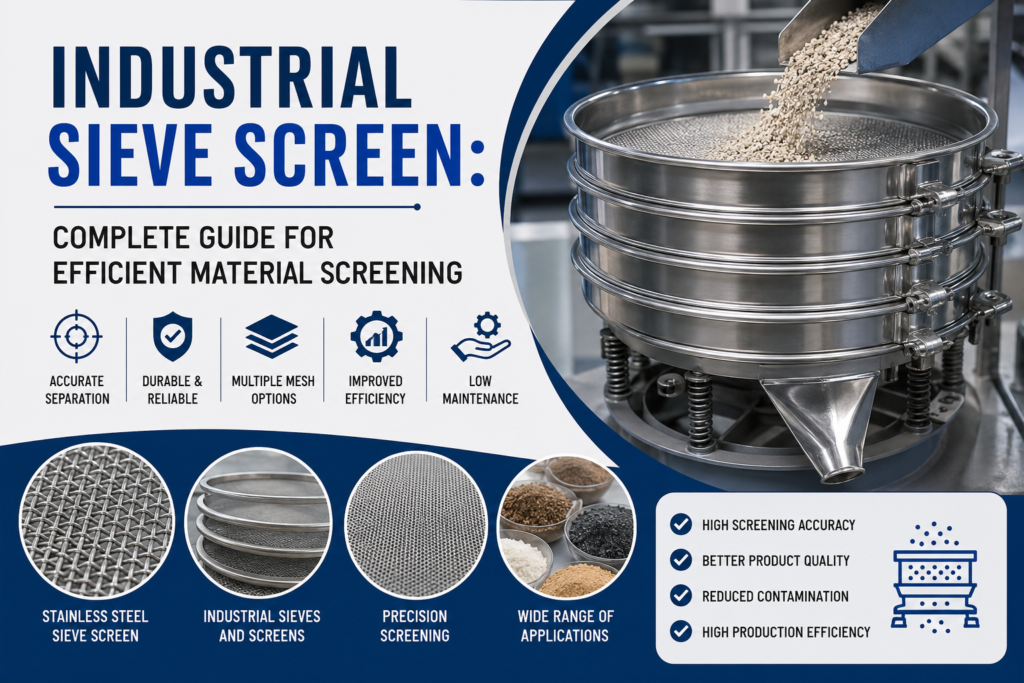
Material screening plays a crucial role in maintaining product quality and improving production efficiency across industries. Whether processing powders, granules, or bulk materials, selecting the right industrial sieve screen ensures consistent particle size, minimizes contamination, and enhances operational performance.
From food and pharmaceutical manufacturing to chemicals and minerals, businesses rely on durable industrial sieves and screens for precise separation. Modern stainless steel sieve screen solutions offer excellent corrosion resistance, longer service life, and hygienic operation, making them ideal for demanding industrial environments.
What is an Industrial Sieve Screen?
An industrial sieve screen is a screening component designed to separate materials based on particle size. It consists of a woven wire mesh or perforated surface mounted within screening equipment such as vibro sifters, vibrating screens, or rotary sifters.
As materials move across the screen, particles smaller than the mesh opening pass through while oversized particles remain on top, ensuring accurate classification and improved product quality.
Why Are Industrial Sieves and Screens Important?
High-quality industrial sieves and screens provide consistent screening performance and help manufacturers maintain production standards.
Key advantages include:
- Accurate particle size separation
- Removal of unwanted impurities
- Improved product consistency
- Higher production efficiency
- Reduced material waste
- Better equipment performance
- Lower maintenance costs
Efficient screening also helps manufacturers comply with industry quality standards.
Benefits of Stainless Steel Sieve Screen
A stainless steel sieve screen is widely preferred because it offers superior durability and hygienic performance.
1. Excellent Corrosion Resistance
Stainless steel withstands moisture, chemicals, and harsh processing conditions without rusting.
2. High Mechanical Strength
The screen maintains its shape even under continuous vibration and heavy workloads.
3. Food-Grade Hygiene
Its smooth surface is easy to clean and suitable for food, pharmaceutical, and chemical applications.
4. Long Service Life
Premium stainless steel screens resist wear and reduce replacement frequency.
5. Consistent Screening Accuracy
Uniform mesh openings ensure reliable particle separation throughout producti
Applications of Industrial Sieve Screen
An sieve screen is used across numerous industries, including:
Food Processing
- Flour screening
- Sugar grading
- Spice separation
- Grain cleaning
- Starch processing
Pharmaceutical Industry
- Tablet powder screening
- API processing
- Granule classification
- Contamination removal
Chemical Industry
- Pigments
- Resins
- Fertilizers
- Industrial powders
- Additives
Mineral Industry
- Sand classification
- Limestone screening
- Silica separation
- Metal powder grading
Recycling Industry
- Plastic granules
- Rubber powder
- Glass particles
- Metal recycling
Factors to Consider When Choosing an Industrial Sieve
Selecting the right screen depends on several important factors.
Material Compatibility
Choose screen material based on product characteristics and processing conditions.
Mesh Size
Select the appropriate mesh opening according to the required particle size.
Wire Diameter
The correct wire thickness balances durability with screening efficiency.
Production Capacity
Ensure the screen supports the required throughput.
Chemical Resistance
For aggressive materials, a stainless steel sieve screen provides better corrosion protection.
Maintenance Requirements
Choose screens that are easy to replace and clean to reduce downtime.
How Sieve Screens Improve Production Efficiency
Modern screening systems help manufacturers achieve:
- Faster material processing
- Better product uniformity
- Reduced contamination
- Lower rejection rates
- Improved equipment reliability
- Increased production output
Reliable screening directly contributes to higher operational efficiency and reduced production costs.
Proper maintenance reduces downtime and improves screening accuracy.
Why Choose High-Quality Industrial Sieves and Screens?
Investing in premium industrial sieves and screens offers long-term operational benefits.
High-quality screens provide:
- Greater durability
- Improved screening accuracy
- Better product quality
- Lower maintenance costs
- Higher production efficiency
- Longer equipment lifespan
Choosing the right screen ensures reliable performance across demanding industrial applications.
Conclusion
An industrial sieve screen is a vital component for achieving accurate material separation, maintaining product quality, and maximizing production efficiency. Whether you’re processing food, pharmaceuticals, chemicals, or minerals, selecting high-quality industrial sieves and screens ensures reliable performance and consistent results.
A durable stainless steel sieve screen offers superior corrosion resistance, hygienic operation, and extended service life, making it the preferred choice for modern manufacturing facilities. By selecting the appropriate mesh size, material, and design, businesses can improve productivity while reducing maintenance costs and material waste.
Frequently Asked Questions (FAQs)
Q . What is an industrial sieve screen used for?
Ans: An industrial sieve screen separates materials by particle size, removes contaminants, and improves product quality in industrial processing.
Q. Why is a stainless steel sieve screen preferred?
Ans: A stainless steel sieve screen offers corrosion resistance, durability, hygienic performance, and long service life, making it ideal for demanding industrial applications.
Q. Which industries use industrial sieves and screens?
Ans: Industrial sieves and screens are commonly used in food processing, pharmaceuticals, chemicals, minerals, agriculture, and recycling industries.
Q. How do I choose the right sieve screen?
Ans: Consider mesh size, material type, wire diameter, production capacity, product characteristics, and operating environment before selecting a screen.
Q . How often should an sieve screen be replaced?
Ans: Replacement depends on usage, material abrasiveness, and maintenance. Regular inspections help identify wear and ensure consistent screening performance.