
Vibro Sifter Screen Manufacturer for Pharma & Industrial Applications
Introduction
A dependable Vibro Sifter Screen Manufacturer is important for industries that need consistent particle separation during powder and granule processing. The right screen helps remove oversized particles, control particle size, and maintain steady material flow through a production process. Vibro sifter screens are widely used in pharmaceutical, API, food, chemical, cosmetic, nutraceutical, Ayurvedic, agrochemical, fertilizer, paint, and other powder-processing applications. Selecting the correct mesh, screen construction, dimensions, and cleaning approach can directly affect screening performance, downtime, and product consistency.
AI Overview Summary:
A vibro sifter screen is a mesh-based screening component used to separate powders and granules by particle size. It helps remove oversized material and maintain consistent screening performance. Pharmaceutical, food, chemical, cosmetic, nutraceutical, and other powder-processing companies use screens matched to their equipment and process requirements.
What Is a Vibro Sifter Screen?
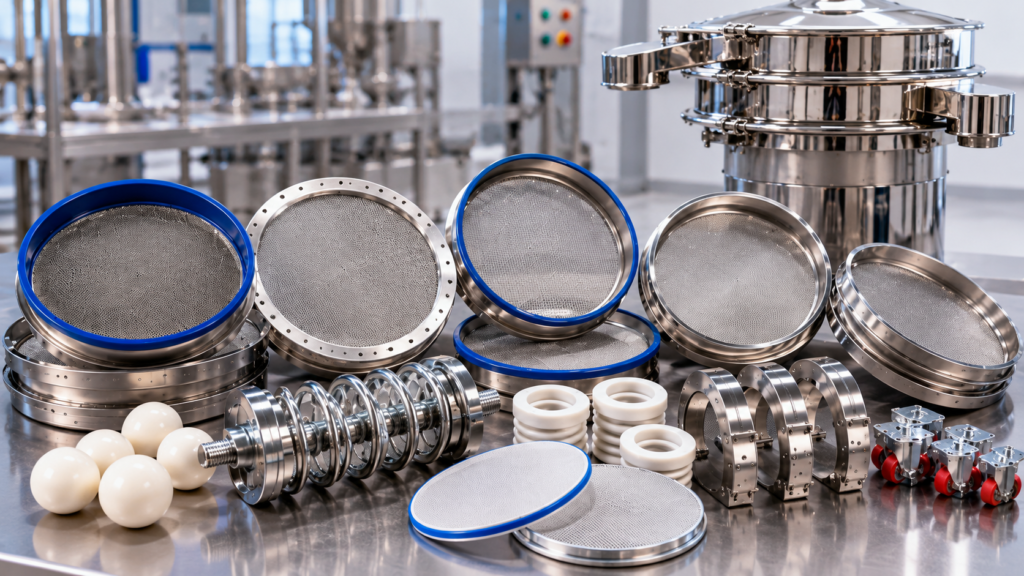
A vibro sifter screen is a precision mesh assembly fitted inside a vibrating screening machine. During operation, vibration moves the powder or granules across the screen surface. Material smaller than the selected mesh openings passes through, while larger particles remain above the screen and are discharged separately.
The screen is therefore one of the most important working components of a vibro sifter. Mesh opening, wire construction, screen diameter, frame design, tension, and product characteristics all influence the final screening result.
A Vibro Sifter Sieves Manufacturer can produce different screen configurations according to machine dimensions and application requirements.
For pharmaceutical processing, equipment and product-contact surfaces also need careful consideration. FDA guidance states that equipment should be appropriate for its intended use and designed to facilitate cleaning and maintenance, while product-contact surfaces should not adversely affect product quality.
Why Is a Vibro Sifter Screen Important?
A worn, damaged, incorrectly sized, or poorly fitted screen can affect screening efficiency and create unnecessary production problems.
A suitable screen helps manufacturers:
- Maintain consistent particle-size separation.
- Remove oversized lumps and unwanted particles.
- Reduce screening interruptions.
- Improve downstream powder processing.
- Support repeatable production performance.
- Reduce unnecessary material loss.
- Simplify screen replacement and maintenance.
For pharmaceutical manufacturers, controlled equipment performance is particularly important because GMP focuses on consistent production, suitable equipment, contamination control, and documented processes.
How Does a Vibro Sifter Screen Work?
The process is relatively simple. Material enters the vibrating sifter and spreads across the mesh surface. Controlled vibration moves the material across the screen.
Particles that are smaller than the mesh openings pass through into the lower collection area. Oversized particles remain above the screen and move toward a separate discharge outlet.
Multiple screening decks can be used when more than one particle-size fraction is required. The actual result depends on mesh selection, material properties, feed rate, vibration conditions, and machine configuration.
Key Features
When evaluating a replacement or new screen, consider these features:
- Precision mesh: Provides controlled separation according to the required particle size.
- Stainless-steel construction: Offers durability and is commonly selected for hygienic processing environments.
- Accurate dimensions: Helps ensure proper fit inside the intended vibro sifter.
- Multiple mesh options: Allows the screen to be matched to different products.
- Strong frame construction: Supports stable operation during continuous vibration.
- Replaceable design: Makes routine maintenance and screen changes easier.
- Custom configurations: Screens can be designed around specific machine and process requirements.
- Cleanable surfaces: Important for applications where hygiene and product changeover matter.
Benefits of Vibro Sifter Screens
A properly selected screen can provide several practical benefits:
- Consistent screening: Maintains predictable separation of powders and granules.
- Better product quality: Helps remove oversized particles before downstream processing.
- Lower downtime: Correctly fitted replacement screens can reduce unnecessary interruptions.
- Improved process efficiency: Effective screening supports smoother material flow.
- Flexible production: Different mesh sizes can accommodate different materials.
- Reduced maintenance problems: Proper construction and fit can improve operating reliability.
- Better hygiene: Suitable materials and cleanable designs support controlled processing environments.
Applications
Vibro sifter screens are used in many industries where dry material classification is required.
Common applications include:
- Pharmaceutical powder and granule screening.
- API and bulk drug processing.
- Food and beverage ingredient screening.
- Chemical and specialty chemical powders.
- Cosmetic and personal-care powders.
- Nutraceutical and supplement ingredients.
- Ayurvedic and herbal powders.
- Agrochemical formulations.
- Fertilizer processing.
- Paint and pigment manufacturing.
- Dairy and dry ingredient processing.
- Industrial powder-processing facilities.
- R&D and pilot-scale production.
They can also be supplied as replacement components for existing vibro sifter machines.
How to Choose the Right Vibro Sifter Screen Manufacturer
Before purchasing, discuss the complete application with the supplier rather than ordering only by screen diameter.
- Confirm machine dimensions: Provide the existing screen diameter, frame dimensions, and machine model where available.
- Select the correct mesh: Mesh size should match the required particle-size separation.
- Understand the product: Powder density, moisture, flowability, abrasiveness, and particle characteristics can affect screen selection.
- Choose suitable construction: Select materials appropriate for the product, cleaning method, and operating environment.
- Check screen tension and fit: A poorly fitted screen can reduce performance and increase wear.
- Ask about replacement support: For production facilities, consistent availability of replacement screens can help reduce downtime.
Companies searching for an Industrial Sifter Screen Manufacturer should also review manufacturing capability, dimensional accuracy, quality checks, customization options, and technical support.
For Gujarat-based sourcing, buyers may specifically look for a Vibro Sifter Mesh Supplier or Vibro Shifter Spare Parts Manufacturer with experience supplying industrial screening components.
Common Mistakes to Avoid
- Selecting mesh size without checking the actual product.
- Ordering a screen without confirming dimensions.
- Focusing only on the lowest price.
- Ignoring material compatibility.
- Using damaged or excessively worn screens for extended periods.
- Failing to inspect the screen for tears or deformation.
- Not keeping replacement screens available for critical production lines.
- Assuming one mesh specification works for every product.
A proper technical discussion before purchase can prevent many of these issues.
Conclusion
The screen is a critical component of a vibro sifter because it directly controls the separation of powders and granules. The right mesh, material, dimensions, frame construction, and fit can improve screening consistency while reducing avoidable downtime.
Whether you operate a pharmaceutical, API, food, chemical, cosmetic, nutraceutical, agrochemical, fertilizer, or powder-processing facility, screen selection should be based on the actual machine and product requirements.
Working with an experienced Vibro Sifter Screen Manufacturer can make it easier to select suitable screens, replacement meshes, and customized configurations. For specific requirements, buyers can share their machine dimensions, mesh specification, product details, and required quantity with the manufacturer for technical guidance.
Frequently Asked Questions
What is a Vibro Sifter Screen?
A vibro sifter screen is a mesh component installed inside a vibrating screening machine. It separates powders and granules according to particle size. Smaller particles pass through the mesh openings, while oversized particles remain on the screen and move toward a separate discharge point.
What are the benefits of a Vibro Sifter Screen?
A suitable screen can improve particle-size consistency, remove oversized particles, support efficient powder processing, and reduce manual screening. Correct dimensions and mesh selection can also help minimize operational interruptions and make routine replacement easier.
Where are Vibro Sifter Screens used?
Vibro sifter screens are used in pharmaceutical, API, food, chemical, cosmetic, nutraceutical, Ayurvedic, agrochemical, fertilizer, paint, pigment, and powder-processing industries. They are useful wherever powders or granules need controlled separation before blending, filling, compression, packaging, or another production process.
How do I choose the right Vibro Sifter Screen?
Start with the machine’s internal dimensions, existing screen specification, required mesh size, product characteristics, and desired separation. Also consider construction material, cleaning requirements, operating conditions, and replacement frequency. Sharing the machine model and application details with the supplier can make selection more accurate.
Is a Vibro Sifter Screen customizable?
Yes. Depending on the manufacturer, screens can be produced in different diameters, mesh sizes, frame configurations, materials, and other dimensions. Customization is particularly useful when replacing screens in older machines or equipment with non-standard dimensions.
What material is best for a Vibro Sifter Screen?
Stainless steel is commonly used where durability, corrosion resistance, and cleanability are important. The appropriate material and grade depend on the processed product, operating environment, cleaning method, and industry requirements. Pharmaceutical and food applications require additional attention to product-contact surfaces.
How often should a Vibro Sifter Screen be replaced?
There is no universal replacement interval. Screen life depends on the material being processed, operating hours, vibration conditions, mesh characteristics, cleaning practices, and mechanical wear. Manufacturers should inspect screens regularly and replace them when damage, deformation, excessive wear, or declining screening performance is observed.
Can I buy replacement screens for an existing Vibro Sifter?
Yes. Replacement screens can generally be manufactured for existing equipment when accurate dimensions and specifications are available. Providing the machine model, screen diameter, mesh size, frame details, and photographs of the existing screen can help a supplier determine the appropriate replacement.
No comment