
Vibro Sifter Sieves: A Guide to Screening and Industrial Sieving
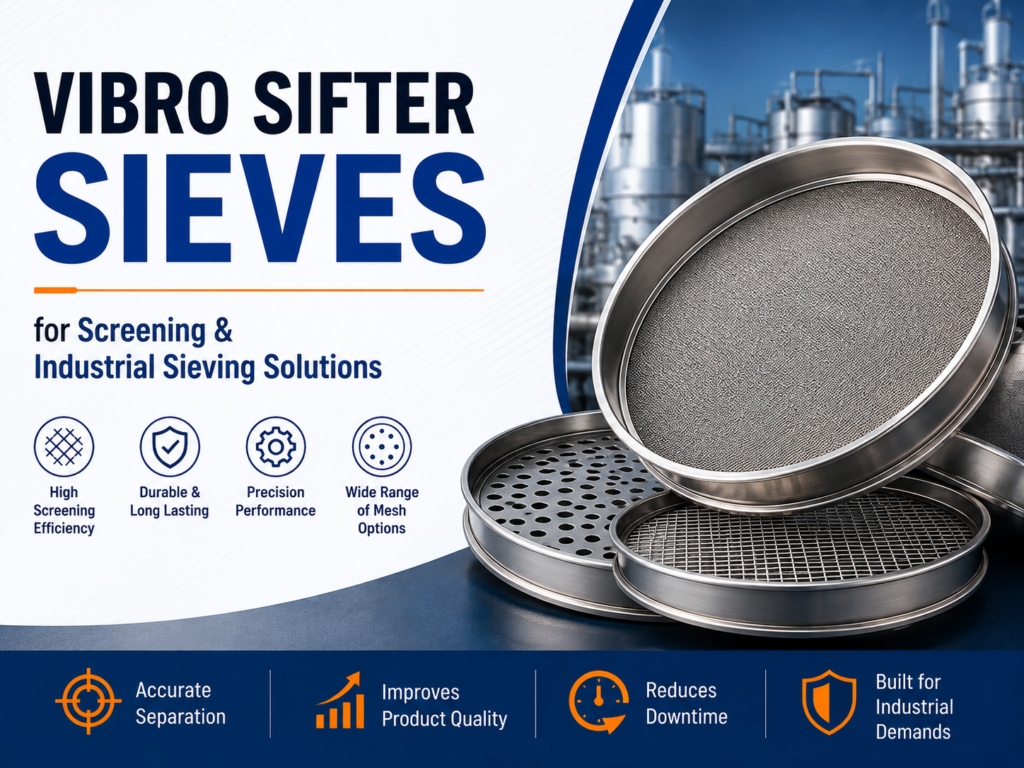
In modern manufacturing, accurate particle separation is essential for maintaining product quality, consistency, and process efficiency. Vibro Sifter Sieves are widely used for this purpose because they provide reliable and controlled screening of powders, granules, and other materials.
From food processing and pharmaceuticals to chemicals and minerals, vibro sifter sieves support efficient screening and industrial sieving operations while helping manufacturers achieve the desired particle size.
What Are Vibro Sifter Sieves?
Vibro sifter sieves are screening components used in vibrating sifting machines to separate materials according to particle size. The sieve is generally fitted into a vibro sifter, where controlled vibration moves the material across the mesh.
Particles smaller than the selected mesh opening pass through, while larger particles remain on the screen. This simple principle makes vibro sifter sieves suitable for applications requiring precise and repeatable separation.
Why Are Vibro Sifter Sieves Important?
Choosing the appropriate sieve can directly affect screening performance. High-quality sieves can help manufacturers:
- Achieve consistent particle-size separation
- Improve screening efficiency
- Reduce unwanted contamination
- Support continuous production
- Minimize material loss
- Maintain consistent product quality
- Simplify cleaning and maintenance
The right mesh specification also helps ensure that the sifting process matches the requirements of the application.
Applications of Vibro Sifter Sieves
Vibro sifter sieves are used across a wide range of industries. Common applications include:
Pharmaceutical Industry
Pharmaceutical manufacturers use sieving systems to separate powders, remove oversized particles, and maintain uniform material characteristics during production.
Food Processing
In food manufacturing, sieves can be used for flour, spices, sugar, starch, and other powdered or granular ingredients. Effective screening helps maintain consistent texture and particle size.
Chemical Industry
Chemical powders and granules often require controlled separation before further processing. Vibro sifter sieves can support efficient screening while handling a variety of materials.
Minerals and Other Industrial Materials
Industrial plants may use vibrating sieves for screening minerals, aggregates, powders, and granulated materials. Selecting the correct mesh helps improve separation accuracy and throughput.
Factors to Consider When Selecting a Sieve
Different applications require different sieve specifications. Before choosing a vibro sifter sieve, consider:
Mesh size: The mesh opening determines the approximate particle size that can pass through the screen.
Material: Stainless steel and other suitable materials may be selected according to the product, operating conditions, and hygiene requirements.
Application: Pharmaceutical, food, chemical, and general industrial applications can have different screening requirements.
Operating capacity: The required throughput should be considered to ensure the sieve can support the production process.
Cleaning requirements: Applications with strict hygiene standards may require designs that are easy to clean and maintain.
Vibro Sifter Sieves and Industrial Sieving Efficiency
Efficient industrial sieving depends on more than simply installing a screen. Factors such as vibration intensity, feed rate, material characteristics, moisture, mesh condition, and sieve selection can all influence performance.
Regular inspection is also important. Damaged or blocked mesh can reduce screening efficiency and affect the consistency of the final product. Cleaning the sieve at appropriate intervals can help maintain reliable operation.
Maintenance Tips for Vibro Sifter Sieves
Proper maintenance can extend sieve life and support consistent screening performance. Some useful practices include:
- Inspect the mesh regularly for wear or damage.
- Clean the sieve according to the material and application requirements.
- Avoid using unsuitable tools that could damage the mesh.
- Check for blocked openings and material buildup.
- Ensure the sieve is correctly installed before operation.
- Replace damaged or excessively worn screens promptly.
Conclusion
Vibro Sifter Sieves are an important part of modern screening systems, providing controlled particle separation for numerous industries. When properly selected and maintained, they can contribute to consistent product quality, efficient processing, and dependable screening and industrial sieving performance.
Understanding factors such as mesh size, material, application, capacity, and maintenance can help businesses choose a sieve solution that fits their specific production requirements.
Contact Mech Tech Steel Industries for more ingormation
Frequently Asked Questions
Q. What are Vibro Sifter Sieves used for?
Ans: Vibro Sifter Sieves are primarily used to separate materials according to particle size. They are commonly used for powders, granules, and other materials across pharmaceutical, food, chemical, and industrial applications.
Q. How do Vibro Sifter Sieves work?
Ans: The sieve is installed in a vibrating sifting machine. Vibration moves the material across the mesh, allowing smaller particles to pass through the openings while larger particles are retained.
Q. How do I choose the right mesh size for a vibro sifter?
Ans: The appropriate mesh size depends on the required particle separation, material characteristics, and production requirements. The desired particle size should be evaluated before selecting the mesh.
Q. What industries use vibro sifter sieves?
Ans: They are widely used in pharmaceutical manufacturing, food processing, chemical production, mineral processing, and various other industrial screening applications.
Q. How can I maintain Vibro Sifter Sieves?
Ans: Regular cleaning, inspection, and proper installation are important. Operators should check the mesh for blockage, wear, or damage and replace the sieve when its performance or structural condition deteriorates.
No comment