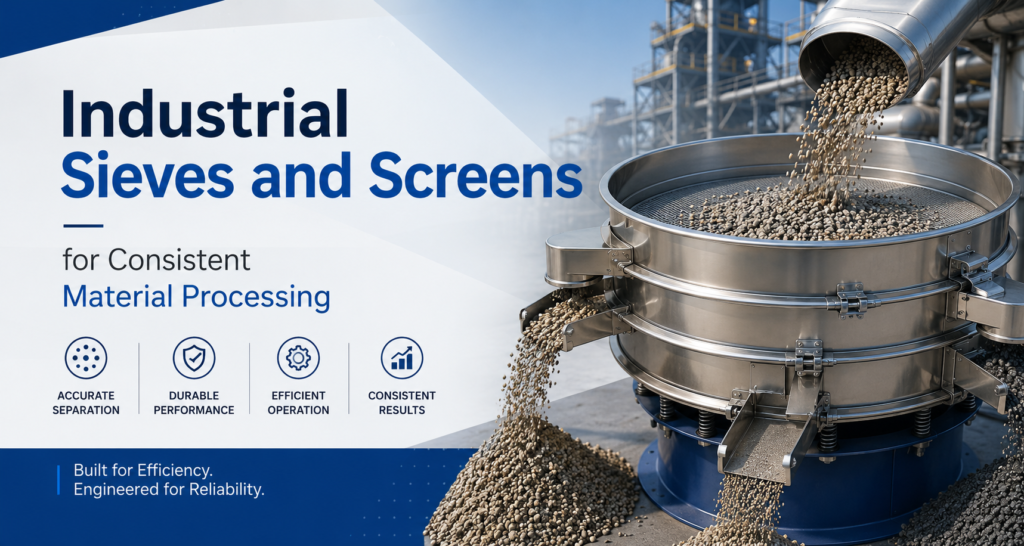
Industrial Sieves and Screens for Consistent Material Processing
Every manufacturing process depends on the quality and uniformity of raw materials. When materials contain oversized particles, lumps, or unwanted contaminants, product quality can suffer and production efficiency may decline. This is where industrial sieves and screens become an essential part of modern processing systems.
From food production plants to pharmaceutical facilities and chemical manufacturing units, screening equipment helps businesses maintain quality standards while improving productivity. A properly selected industrial sieve screen ensures accurate separation of materials and supports smooth operation throughout the production cycle.
Understanding Industrial Sieves and Screens
Industrial sieves and screens are specially designed mesh-based components used to separate materials according to particle size. They allow particles of a desired size to pass through while retaining larger or unwanted materials.
Unlike manual sorting methods, modern screening solutions provide faster processing, greater accuracy, and better consistency. As industries continue to demand higher product quality, the importance of reliable screening equipment has increased significantly.
Why Screening Is Important in Industrial Operations
Many industries process powders, granules, liquids, and bulk materials. Variations in particle size can affect product performance, packaging, appearance, and customer satisfaction.
Using high-quality industrial sieves and screens offers several operational advantages:
- Better control over product quality
- Removal of foreign particles and impurities
- Improved production efficiency
- Reduced material wastage
- Consistent end-product specifications
- Enhanced equipment performance
These benefits make screening an important step in many manufacturing environments.
Advantages of Stainless Steel Sieve Screens
A stainless steel sieve screen is widely preferred because of its strength, durability, and ability to withstand demanding industrial conditions.
Excellent Resistance to Corrosion
Many industrial processes involve moisture, chemicals, or cleaning agents. Stainless steel remains resistant to corrosion, making it suitable for long-term use.
Durable Construction
A stainless steel sieve screen can handle continuous vibration and heavy material loads without losing its structural stability.
Easy Cleaning and Maintenance
The smooth surface of stainless steel helps prevent material buildup and supports hygienic processing environments.
Reliable Screening Accuracy
Uniform mesh openings help achieve precise particle separation, ensuring consistent production results.
Suitable for Multiple Industries
Because of its versatility, stainless steel screening media can be used across a wide range of industrial applications.
Industries That Depend on Industrial Sieves and Screens
Food and Beverage Processing
Manufacturers use screening systems to process flour, spices, sugar, starch, and other food ingredients while maintaining product purity.
Pharmaceutical Manufacturing
Medicines and healthcare products require uniform particle sizes. Screening equipment helps ensure quality and regulatory compliance.
Chemical Processing
Industrial screening systems separate powders and raw materials used in paints, pigments, detergents, and specialty chemicals.
Agriculture Sector
Seeds, fertilizers, and agricultural products often require grading and classification before packaging and distribution.
Mineral and Mining Applications
Mining operations rely on screening technology to classify materials and improve processing efficiency.
Selecting the Right Industrial Sieve Screen
Not all screening applications have the same requirements. Choosing the correct industrial sieve screen can improve both efficiency and product quality.
Important factors include:
Mesh Specification
The mesh size determines which particles pass through and which are retained.
Material Compatibility
The screen material should be compatible with the product being processed.
Throughput Requirements
High-capacity operations may require screens designed for continuous processing.
Operating Conditions
Temperature, moisture levels, and product characteristics should be considered before selecting a screen.
Maintenance Requirements
Easy-to-clean and replaceable screens help reduce downtime and maintenance costs.
How Regular Maintenance Improves Screen Performance
Even high-quality industrial sieves and screens require routine inspection and maintenance. Proper care helps maintain screening accuracy and extends service life.
Recommended maintenance practices include:
- Checking mesh integrity regularly
- Removing accumulated material after operation
- Monitoring for wear and damage
- Replacing damaged screens promptly
- Following manufacturer-recommended cleaning procedures
Preventive maintenance helps avoid production interruptions and ensures reliable performance.
The Future of Industrial Screening Technology
As manufacturing processes become more advanced, screening systems continue to evolve. Modern designs focus on higher throughput, better precision, and reduced maintenance requirements. Many industries are increasingly choosing stainless steel sieve screen solutions because of their long service life and dependable performance.
Companies that invest in advanced screening technology often benefit from improved product quality, lower operating costs, and greater production efficiency.
Conclusion
Efficient screening is an important step in maintaining product quality and process reliability. High-performance industrial sieves and screens help manufacturers achieve accurate particle separation, reduce waste, and improve operational efficiency. Whether processing food ingredients, pharmaceutical powders, chemicals, or minerals, selecting the right industrial sieve screen and durable stainless steel sieve screen can contribute significantly to long-term manufacturing success.
Frequently Asked Questions
1. What is the purpose of industrial sieves and screens?
They are used to separate, classify, and filter materials according to particle size during manufacturing and processing operations.
2. Why are stainless steel sieve screens commonly used?
They offer excellent durability, corrosion resistance, hygienic properties, and long service life.
3. How do I determine the correct mesh size for my application?
The required mesh size depends on the particle size range and screening objective of your process.
4. Can industrial sieve screens be customized?
Yes. Manufacturers can provide screens in different mesh sizes, diameters, and specifications based on application requirements.
5. How often should a sieve screen be inspected?
Regular inspections should be conducted based on production volume and operating conditions to ensure optimal performance.