
How to Choose Vibro Sifter Sieves for Industrial Screening Needs
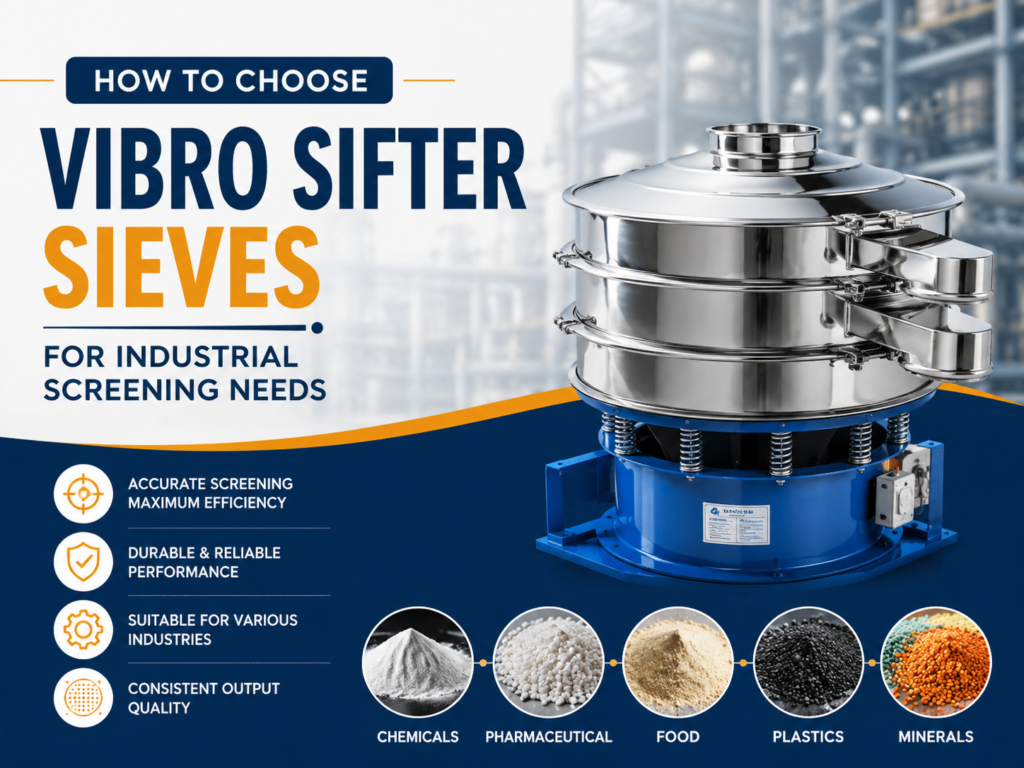
Selecting the right Vibro Sifter Sieves can make a significant difference to screening efficiency, product quality, and overall production performance. In industries where powders, granules, and other materials need precise particle-size separation, the sieve is not simply a replaceable machine component—it is a critical part of the screening process.
Different materials behave differently during screening. Fine powders may clog the mesh, sticky materials may reduce flow, and abrasive products can cause premature wear. Therefore, choosing the correct sieve requires consideration of mesh size, material, opening pattern, product characteristics, and operating conditions.
This guide explains the key factors to consider when selecting Vibro Sifter Sieves for screening and industrial sieving applications.
Why Sieve Selection Matters in Industrial Screening
The performance of a vibro sifter depends heavily on the condition and specification of its screening surface. An unsuitable sieve can lead to poor separation, reduced throughput, frequent cleaning, and increased material wastage.
The right sieve helps maintain:
- Consistent particle-size separation
- Smooth material flow
- Better screening efficiency
- Reduced mesh blockage
- Improved product quality
- Longer operating life
- Lower maintenance requirements
For this reason, sieve selection should be based on the actual application rather than choosing a mesh only by its nominal size.
1. Start With the Required Particle Size
The first consideration when selecting Vibro Sifter Sieves is the required separation size.
The mesh opening determines which particles can pass through the screen. If the opening is too large, oversized particles may pass through. If it is too small, the screening process may become slower and the mesh may be more susceptible to blockage.
Before selecting the sieve, determine:
- Required particle size
- Desired separation accuracy
- Percentage of oversize material
- Required product fineness
- Number of screening stages
For applications requiring multiple particle-size classifications, a vibro sifter may use multiple screening decks with different mesh specifications.
2. Consider the Material Being Screened
Material characteristics have a direct impact on sieve performance.
A dry, free-flowing powder may screen easily through a conventional mesh, while a fine or cohesive powder may stick to the screen surface. Similarly, abrasive materials can cause greater wear over time.
Important material characteristics include:
Particle Size
The average and maximum particle size help determine the appropriate mesh opening.
Moisture Content
Moist or hygroscopic materials may stick to the mesh and reduce screening efficiency.
Particle Shape
Irregular particles may behave differently from spherical particles during screening.
Bulk Density
Lightweight powders may require different screening conditions compared with heavier granular materials.
Abrasiveness
Abrasive products can increase mesh wear and may require a more durable sieve construction.
Understanding these factors before purchasing or replacing a sieve can prevent many common screening problems.
3. Choose the Appropriate Sieve Material
The material used to manufacture the sieve is another important consideration.
Depending on the application, manufacturers may require stainless steel or other suitable mesh materials. For food, pharmaceutical, and hygiene-sensitive applications, material compatibility and cleanability are particularly important.
The sieve material should be selected based on:
- Product compatibility
- Operating environment
- Temperature
- Corrosion resistance
- Cleaning requirements
- Expected service life
A suitable material can help maintain product integrity while reducing premature deterioration of the screening surface.
4. Understand Mesh Size and Screening Requirements
Mesh size is one of the most commonly considered specifications when purchasing Vibro Sifter Sieves, but it should not be considered in isolation.
Two sieves may have different construction characteristics even when they are intended for similar particle-size separation. Wire diameter, opening size, mesh arrangement, and manufacturing quality can all affect performance.
For this reason, users should provide the supplier with the actual screening requirement rather than simply requesting a generic mesh.
For accurate selection, mention:
- Target particle size
- Product type
- Machine model
- Required capacity
- Screening purpose
- Existing sieve specification, if available
This information allows the sieve to be matched more appropriately to the application.
5. When Should You Consider Ultrasonic Sifters?
Fine powders can create a common challenge during screening and industrial sieving: mesh blockage.
When very fine particles accumulate around the mesh openings, the effective screening area can decrease. This may result in lower throughput and inconsistent separation.
In such applications, ultrasonic sifters can be considered.
Ultrasonic screening systems introduce high-frequency vibrations to the screening mesh. These vibrations can help keep fine particles moving through the openings and reduce the tendency of the mesh to become blocked.
Ultrasonic sifters may be useful for:
- Very fine powders
- Difficult-to-screen materials
- Low-density products
- Materials prone to blinding
- Applications requiring fine particle separation
However, ultrasonic technology is not necessary for every application. Conventional Vibro sieves may be sufficient when the material is free-flowing and the required particle size is relatively easy to achieve.
6. Vibro Sieves for Different Industrial Applications
Different industries have different screening requirements, so the sieve specification should be selected according to the application.
Pharmaceutical Processing
Pharmaceutical powders and granules often require controlled particle-size separation and hygienic processing. The sieve should support effective screening while being suitable for cleaning and maintenance procedures.
Food Processing
Food ingredients such as flour, spices, sugar, and powdered ingredients may require screening to remove lumps and oversized particles. Product-contact materials and easy cleaning can be important considerations.
Chemical Processing
Chemical powders and granules may require screening for classification, impurity removal, or preparation before further processing. Corrosion resistance and material compatibility may be important depending on the product.
Mineral Processing
Mineral and abrasive materials can place greater demands on the screening surface. Durability and resistance to wear should therefore be considered during sieve selection.
Common Vibro Sifter Sieve Problems
Even a correctly selected sieve can experience problems if it is not maintained properly or if operating conditions change.
Mesh Blinding
Fine particles can block the mesh openings, reducing the effective screening area.
Possible solution: Check material moisture, feed conditions, cleaning practices, and consider ultrasonic assistance for suitable fine-powder applications.
Reduced Screening Capacity
Low output may result from incorrect mesh selection, excessive feed rate, material characteristics, or sieve damage.
Possible solution: Review the feed rate and screening parameters and inspect the sieve for blockage or damage.
Damaged Mesh
Continuous operation with abrasive materials or incorrect handling can damage the mesh.
Possible solution: Inspect the sieve regularly and replace damaged screening surfaces before they affect product quality.
Inconsistent Separation
If particles are not being separated consistently, the mesh specification or machine operating conditions may need to be reviewed.
Possible solution: Compare the required particle size with the actual sieve opening and check machine settings.
How to Extend the Life of Vibro Sifter Sieves
Proper handling and maintenance can help increase sieve service life.
Avoid using damaged cleaning tools that can deform the mesh. Clean the sieve according to the material and application requirements, and avoid unnecessary mechanical force.
Regularly inspect:
- Mesh condition
- Sieve frame
- Clamping arrangement
- Seals and gaskets
- Product-contact surfaces
- Signs of corrosion or wear
It is also important to avoid overloading the machine. Excessive feed rates can reduce screening efficiency and place unnecessary stress on the screening system.
What to Check Before Ordering a Replacement Sieve
When ordering replacement Vibro Sifter Sieves, providing complete technical information can make the selection process easier.
Ideally, provide:
- Machine or sifter model
- Sieve diameter and dimensions
- Required mesh size
- Product being screened
- Desired particle size
- Required screening capacity
- Number of decks
- Application environment
- Existing sieve specifications
If the existing sieve is available, sharing its dimensions or specifications with the supplier can also help ensure compatibility.
Conventional Vibro Sieves or Ultrasonic Sifters?
There is no single screening solution suitable for every material.
Conventional Vibro sieves are often suitable for general-purpose screening where materials flow freely through the mesh. They can provide an effective and economical solution for many industrial applications.
Ultrasonic sifters, on the other hand, can be considered when fine powders create mesh blockage or when conventional screening does not provide the required performance.
The decision should be based on actual material behavior, required particle size, production capacity, and screening objectives.
Key Factors to Remember
Before selecting a sieve, evaluate the complete screening application rather than focusing only on mesh size.
The most important factors include:
- Particle-size requirement
- Material characteristics
- Feed rate
- Sieve diameter
- Mesh specification
- Sieve material
- Product compatibility
- Cleaning requirements
- Fine-screening challenges
- Expected operating conditions
A correctly selected screening surface can contribute to more consistent separation and help minimize avoidable production issues. Contact to Mech Tech Steel Industries for more information
Frequently Asked Questions
Q. How do I choose the right Vibro Sifter Sieves?
Ans: Choose the sieve according to the required particle size, material characteristics, machine dimensions, feed rate, and screening capacity. The supplier should also know the sifter model and application requirements.
Q. What causes Vibro Sifter Sieves to clog?
Ans:Fine particles, moisture, sticky materials, electrostatic behavior, and excessive feed rates can contribute to mesh blockage. Reviewing material conditions and screening parameters can help identify the cause.
Q. Are ultrasonic sifters better than conventional vibro sieves?
Ans:Not necessarily. Conventional vibro sieves work effectively for many materials. Ultrasonic sifters are particularly useful when fine powders cause mesh blinding or when very fine screening is required.
Q. How often should Vibro Sifter Sieves be replaced?
Ans:Replacement frequency depends on material abrasiveness, operating hours, cleaning methods, and sieve condition. The mesh should be inspected regularly and replaced when damaged, stretched, or unable to deliver consistent screening results.
Q. Can one sieve be used for different materials?
Ans: A sieve may be used for different materials if the mesh specification, material compatibility, cleaning requirements, and screening conditions are suitable. For hygiene-sensitive or cross-contamination-prone applications, dedicated sieves may be preferable.
Conclusion
Choosing the right Vibro Sifter Sieves requires understanding the material, particle-size requirement, machine configuration, and desired screening performance. Factors such as mesh size, sieve material, feed rate, and cleaning requirements can directly influence the effectiveness of screening and industrial sieving.
For standard applications, Vibro sieves can provide reliable particle separation. When fine powders present mesh-blinding or throughput challenges, ultrasonic sifters may offer an additional screening solution.
By matching the sieve to the actual application and maintaining it correctly, manufacturers can achieve more consistent screening performance, reduce avoidable downtime, and support efficient industrial processing.