Industrial Sieve & Filtration System Manufacturer: A Complete Buying Guide
Introduction
Industrial sieving and filtration are essential processes in industries that handle powders, granules, liquids, and other raw materials. The right equipment helps remove unwanted particles, maintain product consistency, and support efficient production. Choosing a reliable Industrial Sieve & Filtration System Manufacturer is important for pharmaceutical, food, chemical, nutraceutical, and powder-processing companies. A suitable system can improve material quality, reduce manual handling, and support process control. Understanding the available equipment, construction materials, and selection criteria helps manufacturers choose a solution that fits their production needs.
Quick Summary: An industrial sieve and filtration system separates unwanted particles from powders, granules, or liquids using screens, meshes, or suitable filter media. These systems help improve product consistency, protect downstream equipment, and support efficient processing. Pharmaceutical, food, chemical, and other manufacturers should select equipment based on material properties, capacity, hygiene, and filtration requirements.
What Is an Industrial Sieve & Filtration System?
An industrial sieve and filtration system is equipment designed to separate materials according to particle size or remove unwanted solids from liquids. Sieving typically uses a mesh or perforated screen, while filtration uses suitable filter media to retain particles as a fluid passes through.
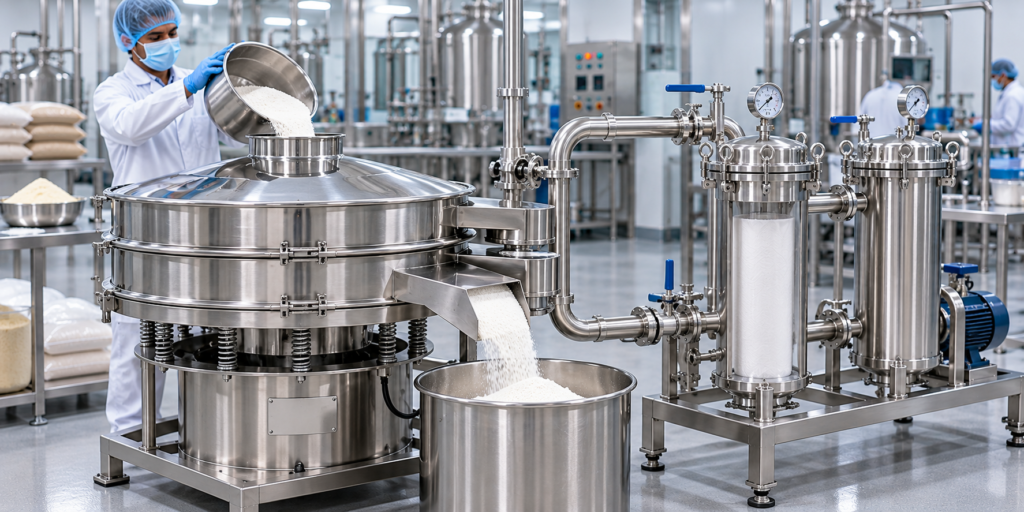
Depending on the application, equipment may include vibratory sieves, rotary sifters, filter housings, mesh screens, and specialized filtration assemblies. The correct design depends on the material being processed and the required separation efficiency.
An experienced Industrial Sieve & Filtration System Manufacturer can help identify suitable equipment based on throughput, particle size, operating conditions, and cleaning requirements.
Why Is It Important?
Raw materials often contain oversized particles, foreign matter, or unwanted solids that can affect the final product. Sieving and filtration help control these issues before materials move to the next production stage.
For example, pharmaceutical manufacturers may use sieving to achieve consistent powder or granule sizes. Food processors may screen ingredients, while chemical plants may filter process liquids to remove suspended solids.
Proper separation can also protect pumps, valves, mixers, and other downstream equipment from unwanted particles. However, the results depend on correct equipment selection, maintenance, and process settings.
Key Features of Industrial Sieve and Filtration Systems
Important features to evaluate include:
- Suitable mesh sizes: Different screen openings help separate particles according to process requirements.
- Appropriate filter media: Filter elements can be selected based on particle retention, flow rate, and chemical compatibility.
- Stainless steel construction: Suitable stainless steel grades can provide corrosion resistance and support cleaning.
- Efficient material handling: Equipment design can help maintain a steady flow of powders, granules, or liquids.
- Easy maintenance: Accessible screens and filter elements simplify inspection and replacement.
- Flexible configurations: Different capacities, connections, and layouts can suit specific production lines.
- Safety and sealing: Proper guards, seals, and enclosures help control leakage, exposure, and material loss.
Benefits of Industrial Sieve and Filtration Systems
A properly selected system can provide several practical benefits:
- Improved product consistency: Controlled separation helps maintain the required particle-size range.
- Reduced contamination risk: Appropriate screening and filtration can remove unwanted particles.
- Equipment protection: Removing unsuitable solids can help reduce wear or blockages in downstream machinery.
- Better productivity: Mechanical separation can reduce the need for manual screening.
- Lower material losses: Suitable equipment and handling arrangements can minimize avoidable product loss.
- Simplified quality control: Repeatable operating conditions make separation performance easier to monitor.
Actual results depend on the material, equipment design, process conditions, and maintenance practices.
Applications Across Industries
Industrial sieving and filtration systems are used in many manufacturing environments.
- Pharmaceutical industry: Screening powders and granules and filtering compatible process liquids.
- API and bulk drug manufacturing: Separating suitable solid materials during processing.
- Food and beverage industry: Screening flour, spices, sugar, and other suitable ingredients.
- Chemical industry: Separating particles from powders, granules, and process liquids.
- Cosmetic manufacturing: Processing compatible powders and filtering selected formulations.
- Nutraceutical and herbal industries: Screening supplement ingredients and dried plant materials.
- Agrochemical and fertilizer industry: Classifying suitable granules and removing oversized particles.
- Paint and pigment industry: Filtering compatible liquid formulations and screening selected dry materials.
How to Choose the Right Industrial Sieve & Filtration System Manufacturer
Before purchasing, consider these six practical factors.
- Define the separation requirement: Identify the particle size, filtration rating, and type of unwanted material you need to remove.
- Understand your material: Share details about moisture, viscosity, abrasiveness, temperature, and chemical compatibility.
- Confirm the required capacity: Compare throughput at your actual operating conditions, not only the machine’s maximum rated capacity.
- Check construction materials: Select suitable stainless steel grades, seals, and filter media for the product and cleaning process.
- Review cleaning and maintenance: Ask about screen replacement, filter changes, inspection access, and cleaning procedures.
- Evaluate technical support: Check drawings, spare-parts availability, warranty terms, and installation assistance.
For replacement parts, an SS Industrial Spares Supplier should provide accurate dimensions, material specifications, and compatibility information. If sourcing from Steel Manufacturing India, confirm the actual steel grade and relevant material documentation instead of relying on the country of origin alone.
Common Mistakes to Avoid
Avoid these common procurement mistakes:
- Choosing mesh size without testing the material.
- Confusing a sieve’s mesh opening with a liquid filter’s micron rating.
- Ignoring pressure, flow rate, viscosity, or required throughput.
- Selecting stainless steel without checking chemical compatibility.
- Overlooking dust containment, sealing, and operator safety.
- Failing to consider screen wear and filter replacement costs.
- Purchasing equipment without confirming installation dimensions and maintenance access.
Conclusion
Industrial sieving and filtration systems help manufacturers maintain material quality, improve production flow, and protect downstream equipment. The right solution depends on the material, separation target, capacity, hygiene requirements, and operating conditions.
If you are planning a new processing line or replacing existing equipment, contact a suitable manufacturer or supplier with your technical requirements. Providing material details, target particle size, throughput, and operating conditions will help the supplier recommend an appropriate configuration.
Frequently Asked Questions
What is an industrial sieve and filtration system?
An industrial sieve and filtration system separates unwanted particles from powders, granules, or liquids. Sieves use screens or meshes to classify solid particles, while filters use suitable media to retain solids as liquids or gases pass through. The equipment type depends on the material and required separation performance.
What are the benefits of industrial sieving and filtration?
These systems can improve product consistency, reduce unwanted particles, protect downstream machinery, and support repeatable processing. Automated separation may also reduce manual handling and material losses. Performance depends on the correct screen or filter selection, operating conditions, and regular maintenance.
Which industries use industrial sieve and filtration systems?
Pharmaceutical, food, chemical, cosmetic, nutraceutical, herbal, agrochemical, and powder-processing companies commonly use these systems. Applications include screening raw materials, classifying granules, and filtering compatible process liquids. Equipment should be selected according to each industry’s material properties, hygiene requirements, and production conditions.
How do I choose the right industrial sieve manufacturer?
Evaluate the manufacturer’s experience with your material, equipment capacity, screen options, construction quality, technical documentation, and after-sales service. Provide the required particle size, throughput, and cleaning requirements. Application-specific testing can help confirm whether the proposed equipment will meet your production needs.
What is the difference between sieving and filtration?
Sieving generally separates solid particles according to size using a mesh or perforated screen. Filtration separates suspended particles from a fluid using suitable filter media. Although both processes remove unwanted material, they use different separation principles and require different equipment specifications.
Why is stainless steel used in industrial sieve systems?
Stainless steel is commonly used because suitable grades can provide corrosion resistance, durability, and cleanable surfaces. The correct grade depends on the material being processed and the cleaning chemicals used. Buyers should verify the grade, surface finish, weld quality, and product-contact requirements before selecting equipment.
Can industrial sieve and filtration systems be customized?
Many systems can be configured with different capacities, mesh sizes, filter media, connections, and material-contact components. Customization depends on the equipment design and application. Share your process requirements, available installation space, and cleaning procedures so the manufacturer can assess a suitable configuration.
How often should sieve meshes and filter elements be replaced?
Replacement frequency depends on material abrasiveness, operating hours, cleaning methods, pressure conditions, and visible wear. Inspect components according to the manufacturer’s maintenance guidance and your quality procedures. Replace damaged meshes or filter elements when they no longer meet the required separation performance or integrity standards.
No comment