

A small difference in a sieve screen can make a noticeable impact on an entire production process. When particles do not separate correctly, production slows down, material may be wasted, and maintaining consistent product quality becomes more difficult. In many cases, the problem is not the screening machine itself but the industrial sieve screen being used.
Choosing the right screen is essential for manufacturers that depend on accurate particle separation, consistent product quality, and reliable production. From powder processing to pharmaceutical and chemical manufacturing, the right mesh can help improve screening performance and reduce unnecessary interruptions.
But how do you select a screen that suits your material, machine, and production requirements?
In this guide, we explore industrial sieve screens, their different types, practical applications, common selection mistakes, and the factors that matter when choosing a suitable screening solution.
What Is an Industrial Sieve Screen and Why Does It Matter?
An industrial sieve screen is a screening surface designed to separate materials according to particle size. It allows particles of a suitable size to pass through its openings while retaining larger particles or unwanted material.
These screens are commonly used in vibratory screening equipment and vibro sifters that process powders, granules, and other materials.
Although the principle is straightforward, screening performance depends on several factors, including mesh aperture, wire diameter, material properties, screen tension, and the movement of the machine.
For example, a screen that works efficiently with dry, free-flowing granules may not deliver the same results with a fine powder that tends to clump or block the mesh.
A properly selected screen can help manufacturers achieve:
- More consistent particle separation.
- Better control over product size.
- Reduced risk of unwanted particles entering the final product.
- Improved screening efficiency.
- More predictable maintenance requirements.
- Reliable performance during routine production.
The important point is that the best sieve screen is not necessarily the finest mesh or the most expensive option. It is the one that matches the actual application.
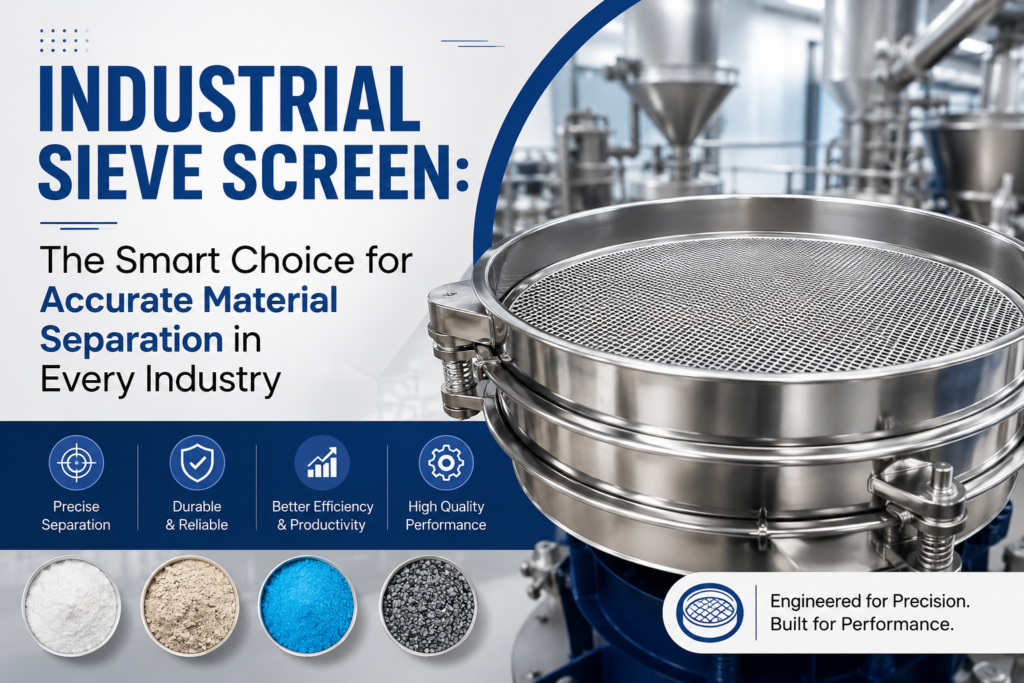
Also Read : Industrial Sieve Screen: The Smart Choice for Accurate Material Separation in Every Industry
5 Industrial Sieve Screen Types Worth Knowing About
Different production requirements call for different screen designs. Understanding the available options can help you narrow down the right solution for your equipment.
1. Stainless Steel Sieve Screen
Stainless steel sieve screens are widely used in industrial screening applications because they can offer durability, corrosion resistance, and precise mesh openings when the appropriate grade and specification are selected.
They may be suitable for pharmaceutical, food processing, chemical, and general manufacturing applications, depending on the material being processed and the required hygiene standards.
When selecting a stainless steel screen, consider the stainless steel grade, wire diameter, mesh aperture, cleaning requirements, and compatibility with the product.
For demanding applications, SS 304 and SS 316 may be considered, but the final choice should depend on the operating environment and applicable product-contact requirements.
2. Epoxy Coated Sifter Sieve
An epoxy coated sifter sieve is a specialised option used in certain industrial screening applications.
The coating and screen construction can influence the screen’s performance, durability, and suitability for a particular process. However, the coating must be appropriate for the material being handled and the operating conditions.
Before choosing an epoxy-coated screen, evaluate the application, cleaning procedure, temperature exposure, and compatibility requirements.
It is also important to confirm whether the coating is suitable for the intended product-contact environment.
This screen type should not be selected based on coating alone. Mesh specifications and the overall construction remain essential.
3. Sandwich Screen for Sifter
A sandwich screen for vibro sifter is a screen assembly in which layers are combined within a supporting construction.
Depending on the design, this construction can provide support and help maintain the required screen configuration during operation.
Sandwich screens may be considered when the application requires a particular screen arrangement or construction. The exact benefits depend on the design, materials, and machine configuration.
Before ordering a replacement, confirm the required dimensions, mesh specifications, frame arrangement, and compatibility with your existing sifter.
A screen that looks similar to the original may not perform correctly if its construction or dimensions differ.
4. Silicone Moulded Sifter Sieve
Silicone-moulded sifter sieves combine a screening mesh with a moulded silicone component.
Depending on the design, this construction can help provide a suitable fit and support specific sealing or hygiene requirements.
These sieves may be considered for applications where cleaning, product compatibility, and the screen assembly’s construction are important.
The silicone compound, mesh material, and manufacturing quality should be checked against the actual application rather than assumed to be suitable for every industrial process.
5. Ultrasonic Industrial Sifter Sieve
Fine powders can sometimes block screen openings, reducing the effective screening area and making separation less efficient.
An ultrasonic industrial sifter sieve is designed to work with an ultrasonic screening system that applies high-frequency vibration to the mesh.
This technology can help reduce mesh blinding in suitable applications, particularly when processing certain fine powders.
However, ultrasonic screening is not a universal solution. Moisture, static electricity, unsuitable mesh specifications, and excessive feed rates can also contribute to screening problems.
Before upgrading, identify the actual cause of the problem and determine whether ultrasonic assistance is appropriate.
How to Choose the Right Industrial Sieve Screen for Your Application
Selecting an industrial sieve screen involves more than choosing a mesh size. The right specification depends on the material, separation target, equipment, and production conditions.
Here are five factors to evaluate before making a decision.
1. Understand the Required Particle Size
Start by identifying which particles need to pass through the screen and which must remain on it.
A mesh that is too coarse may allow unwanted oversized particles to pass. A mesh that is unnecessarily fine may restrict material flow or increase the likelihood of blockage.
Remember that mesh count alone does not fully describe a screen. The aperture size and wire diameter also affect its performance.
Practical tip: Confirm the required particle-size specification before selecting the mesh. For critical applications, validate the selection through a material trial.
Understanding particle size analysis helps manufacturers evaluate separation requirements and select a suitable screening mesh. For further technical guidance, refer to the particle size analysis standard
2. Consider the Material Being Processed
Different materials behave differently during screening.
Dry, free-flowing granules may pass through a screen relatively easily, while damp, cohesive, or electrostatically charged powders can stick together or block the openings.
Consider the following material characteristics:
- Particle size distribution.
- Particle shape.
- Moisture content.
- Abrasiveness.
- Bulk density.
- Tendency to generate static electricity.
- Sensitivity to contamination.
These characteristics can help determine the most appropriate mesh material and screen configuration.
3. Check the Screen Material and Construction
Screen material should match the chemical, mechanical, and environmental demands of the process.
Stainless steel may be appropriate for many industrial applications, while specialised coated or moulded constructions may be worth evaluating for specific requirements.
Also inspect the screen frame, joints, mesh tension, and overall finish.
For applications with strict hygiene or product-contamination controls, ensure that the complete assembly meets the relevant requirements. The material alone does not establish compliance.
4. Match the Screen to Your Machine
Even a well-manufactured screen can perform poorly if it does not fit the machine correctly.
Before ordering, verify:
- Screen diameter and dimensions.
- Frame or ring configuration.
- Mesh aperture and wire diameter.
- Screen construction.
- Mounting and sealing arrangements.
- Compatibility with the existing equipment.
If you are replacing an existing screen, use the original specifications and machine details as a starting point.
Where specifications are unavailable, consult the equipment supplier before finalising the order.
5. Consider Cleaning and Maintenance
Screen performance can change over time because of material accumulation, wear, damage, or changes in mesh tension.
Choose a screen that suits the cleaning methods and inspection procedures used in your facility.
Establish a routine for checking the mesh, frame, joints, and sealing areas. Any damaged screen should be assessed promptly and replaced when necessary.
For sensitive applications, follow documented inspection and product-quality procedures to minimise contamination risks.
Common Industrial Sieve Screen Problems and What They May Mean
When screening performance drops, replacing the screen immediately is not always the best first step. Identifying the cause can help prevent the same problem from recurring.
| Problem | Possible Cause | Recommended Action |
|---|---|---|
| Slow material flow | Fine mesh, excessive feed, or unsuitable material behaviour | Review mesh specifications and feed rate |
| Frequent mesh blockage | Moisture, static, or cohesive particles | Investigate material conditions and screen suitability |
| Inconsistent particle separation | Incorrect aperture or damaged mesh | Check the mesh specification and inspect the screen |
| Premature screen damage | Abrasive material, excessive loading, or unsuitable construction | Review operating conditions and screen selection |
| Material leakage around the screen | Poor fit, damaged seals, or incorrect assembly | Inspect the frame, seals, and installation |
| Frequent cleaning requirements | Material accumulation or unsuitable screening configuration | Review cleaning procedures and consider alternative screen designs |
These are possible causes, not definitive diagnoses. The correct action depends on the machine, material, and operating conditions.
If your screening process uses a vibro sifter, inspect the relevant supporting components as well. Worn clamps, damaged gaskets, or incorrectly fitted parts can affect the overall assembly.
You can explore related components on our Vibro Sifter Spare Parts page.
Which Industries Use Industrial Sieve Screens?
Industrial sieve screens support different production processes where particle separation, grading, or removal of unwanted material is required.
Pharmaceutical Industry
Pharmaceutical manufacturers may use screening to support powder processing and particle-size control.
Screen materials, construction, cleanability, and inspection procedures should be selected according to the product, equipment, and applicable quality requirements.
Food Processing Industry
Food processing operations may use screens to grade ingredients, remove oversized particles, and support product consistency.
The screen assembly must be appropriate for the intended food-contact application, including its material, finish, cleanability, and contamination-control requirements.
Chemical Industry
Chemical manufacturers use screening in various powder and granule processing operations.
Material compatibility, abrasion resistance, operating conditions, and cleaning requirements are important considerations when choosing a screen.
Nutraceutical and Cosmetic Manufacturing
These industries may require screening solutions for powders, blended ingredients, and other processed materials.
The correct screen specification depends on the material characteristics, required separation, and the quality standards of the individual process.
Across all these industries, selecting a suitable screen begins with understanding the production requirement rather than choosing a product based on appearance alone.
When Should You Replace an Industrial Sieve Screen?
A screen does not always fail suddenly. Its condition may deteriorate gradually, affecting screening performance before a major problem becomes obvious.
Watch for these warning signs:
- Visible tears, holes, or broken mesh wires.
- Mesh openings that have become distorted.
- Repeated problems with particle separation.
- Damage to the screen frame or joints.
- Persistent leakage around the assembly.
- Unusual wear or recurring maintenance issues.
A damaged screen should not continue operating simply because the machine is still running.
Inspect the screen according to your facility’s maintenance procedures. If damage is found, assess the affected material and follow the appropriate quality-control process before returning the equipment to service.
Timely replacement can help reduce unplanned interruptions and prevent an unsuitable screen from compromising product quality.
Why Choose Mech Tech Steel Industries for Sieves and Screens?
Choosing an industrial screen supplier involves more than comparing prices. The product must match your equipment, material, and intended operating conditions.
Mech Tech Steel Industries offers a range of sieves and screens for industrial screening requirements, including epoxy coated sifter sieves, sandwich screens, Z-section sifter sieves, silicone-moulded sifter sieves, ultrasonic industrial sifter sieves, and wire mesh rolls.
When evaluating a screen for your application, it is helpful to have the following information ready:
- Existing machine make and model, if available.
- Required screen dimensions.
- Mesh aperture or existing mesh specification.
- Material being processed.
- Desired separation result.
- Relevant operating and cleaning conditions.
Providing these details can help clarify the product specification and reduce the risk of ordering an unsuitable replacement.
Whether you need a replacement screen or are evaluating a different screen configuration, the focus should remain on compatibility, reliable screening, and the actual needs of your production process.
Explore our [Sieves & Screens product range] to find a suitable screening solution for your application.
Conclusion
An industrial sieve screen may be a small part of a production line, but its specification can influence separation accuracy, material flow, maintenance requirements, and overall process reliability.
The right choice depends on particle size, material characteristics, mesh construction, machine compatibility, and cleaning requirements.
From stainless steel screens to epoxy coated sifter sieves, sandwich screens, silicone-moulded sieves, and ultrasonic screening solutions, each option should be evaluated according to the application it needs to serve.
Rather than selecting a screen based on mesh count or price alone, start with your actual process requirements and confirm the specifications before purchasing.
Looking for an industrial sieve screen for your production equipment? Contact Mech Tech Steel Industries to discuss your requirements and identify a suitable screening solution.
Frequently Asked Questions
1. What is an industrial sieve screen used for?
An industrial sieve screen separates particles according to size. It is used in processes such as powder screening, granule grading, product classification, and the removal of unwanted oversized material.
2. How do I choose the right industrial sieve screen?
Consider the required particle size, material properties, mesh aperture, wire diameter, screen material, machine dimensions, and cleaning requirements. For demanding applications, test the screen with the actual material before finalising the specification.
3. What is an epoxy coated sifter sieve?
An epoxy coated sifter sieve is a specialised screen option featuring an epoxy coating. Its suitability depends on the coating specification, screen construction, product compatibility, cleaning requirements, and operating conditions.
4. What is a sandwich screen for a sifter?
A sandwich screen is a screen assembly that combines layers within a supporting construction. Its specific design and performance characteristics depend on the manufacturer’s configuration and the intended application.
5. Can ultrasonic screening prevent mesh blockage?
Ultrasonic screening can help reduce certain types of mesh blockage in suitable applications. However, it cannot correct every cause of blockage, so material properties, moisture, static, feed rate, and mesh selection should also be evaluated.
6. How often should an industrial sieve screen be replaced?
There is no universal replacement interval. Inspect the screen according to its usage, material exposure, operating conditions, and maintenance schedule. Replace damaged or unsuitable screens promptly.
7. Where can I find industrial sieve screens in India?
Mech Tech Steel Industries offers a range of industrial sieves and screens. Buyers should confirm the required dimensions, mesh specifications, screen construction, and machine compatibility before placing an order.
No comment