
Screening and Industrial Sieving: The Complete Guide to Cleaner, Faster, and More Accurate Material Separation
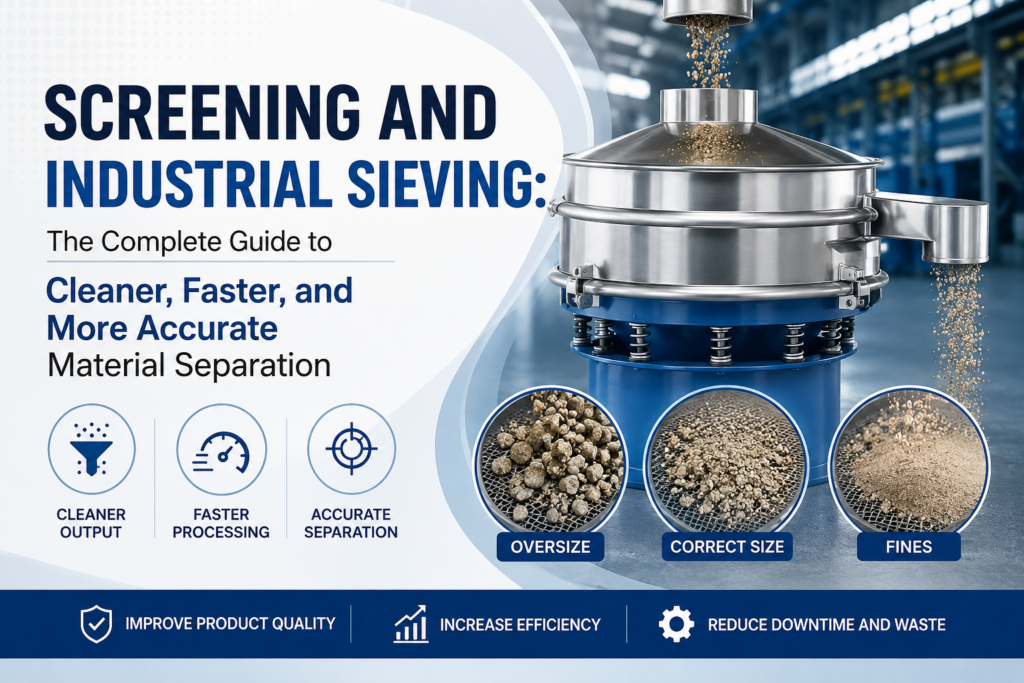
Whether you’re producing pharmaceutical powders, food ingredients, construction materials, or specialty chemicals, one challenge remains the same—maintaining consistent product quality while minimizing waste. Even the smallest oversized particle or unwanted contaminant can affect the performance, appearance, and safety of the final product. That’s why manufacturers across industries rely on screening and industrial sieving to achieve accurate material separation.
At first glance, sieving may seem like a straightforward process. Material enters one end of the machine, passes through a mesh screen, and exits as separated fractions. In reality, achieving reliable, high-capacity screening requires much more than choosing the right mesh size. Factors such as material characteristics, vibration intensity, screen design, and machine configuration all influence the final results.
Modern industries demand faster production, stricter quality standards, and lower maintenance costs. Advanced industrial sieve screen systems and sieves and ultrasonic sifters have become essential tools for improving efficiency while ensuring every batch meets quality expectations.
This guide explores how industrial screening works, the different types of sieving equipment available, practical buying advice, common mistakes to avoid, and expert recommendations for choosing the right solution for your application.
Why Screening and Industrial Sieving Matters More Than Eve
Manufacturing today is about more than producing large volumes. Customers expect consistency, regulatory compliance, and high-quality products every time.
Industrial screening plays a critical role by separating particles according to size, removing contaminants, and preparing raw materials for downstream processing.
Without effective sieving, manufacturers may experience:
- Product contamination
- Uneven particle distribution
- Reduced production efficiency
- Frequent equipment blockages
- Increased material waste
- Customer complaints due to inconsistent quality
From pharmaceutical manufacturing to food processing, screening directly impacts product performance and customer satisfaction.
Understanding Industrial Sieve Screen Technology
An industrial sieve screen is the heart of every screening system. It determines which particles pass through and which remain on top.
Different applications require different screen materials, mesh sizes, and constructions.
Common screen materials include:
| Screen Material | Best For | Benefits |
|---|---|---|
| Stainless Steel | Food & Pharma | Corrosion resistant |
| Spring Steel | Mining | High durability |
| Woven Wire Mesh | General Industry | Excellent accuracy |
| Perforated Plate | Heavy Materials | Long service life |
Selecting the wrong screen often leads to reduced capacity, mesh damage, and inconsistent product quality.
High-quality screens maintain their opening size longer, ensuring accurate particle separation throughout production.
How Screening and Industrial Sieving Works
Although every machine differs slightly, the process follows a simple principle.
Step 1: Material Feeding
Raw material enters the machine through an inlet.
Uniform feeding improves separation efficiency.
Step 2: Vibration
The machine generates controlled vibration that spreads material evenly across the screen.
Particles continually move while seeking screen openings.
Step 3: Particle Separation
Smaller particles pass through the mesh.
Larger particles continue moving toward the discharge outlet.
Step 4: Product Collection
Separated materials exit through dedicated outlets for further processing.
Modern systems allow multiple grades to be separated in a single operation.
Industrial Applications That Depend on Efficient Sieving
Almost every manufacturing sector benefits from industrial screening.
Food Industry
Manufacturers use sieving for:
- Flour
- Sugar
- Salt
- Spices
- Milk powder
- Protein powders
The process removes foreign particles while maintaining consistent texture.
Pharmaceutical Industry
Medicine manufacturers require highly accurate particle separation.
Industrial sieving ensures:
- Uniform powder size
- Improved tablet quality
- Better ingredient mixing
- Regulatory compliance
Chemical Industry
Chemical powders often contain lumps formed during storage.
Screening removes oversized particles before mixing and packaging.
Metal Powder Industry
Fine metal powders require extremely precise classification.
Accurate sieving improves additive manufacturing and powder metallurgy processes.
Construction Industry
Screening separates:
- Cement
- Sand
- Fly ash
- Minerals
Uniform particle size improves construction quality.
When Sieves and Ultrasonic Sifters Become the Better Choice
Some materials are extremely fine or sticky.
Traditional vibrating screens may struggle because fine particles clog the mesh openings.
That’s where sieves and ultrasonic sifters offer a major advantage.
Ultrasonic systems generate high-frequency vibrations directly on the screen surface.
These microscopic vibrations prevent particles from sticking to the mesh.
Benefits include:
- Higher screening efficiency
- Less mesh blinding
- Faster production
- Better separation accuracy
- Reduced downtime
- Longer screen life
Ultrasonic sifters are especially useful for:
- Pharmaceutical powders
- Fine chemicals
- Cosmetic ingredients
- Metal powders
- Ceramic materials
- Battery materials
If your production frequently stops because screens become blocked, ultrasonic technology may significantly improve efficiency.
How to Choose the Right Screening Equipment
Not every screening machine performs equally well.
Choosing the right equipment begins with understanding your material.
Consider Particle Size
Very fine powders require different screens than coarse granules.
Always match mesh size with product specifications.
Evaluate Production Capacity
Buying an oversized machine increases operating costs.
An undersized machine creates production bottlenecks.
Choose equipment that comfortably meets both current and future demand.
Material Characteristics
Ask yourself:
- Is the material sticky?
- Is it abrasive?
- Is it moist?
- Does it contain oils?
- Is it fragile?
These characteristics influence machine selection.
Industry Standards
Food and pharmaceutical industries often require sanitary designs with stainless steel construction and easy cleaning features.
Buying Guide: What Experienced Buyers Always Check
Many purchasing decisions focus only on price.
Experienced manufacturers look much deeper.
Machine Construction
Look for:
- Heavy-duty frame
- Food-grade stainless steel
- Precision welding
- Smooth internal surfaces
Screen Quality
A premium screen provides:
- Better separation
- Longer service life
- Lower maintenance
- Higher productivity
Motor Performance
Reliable vibration motors ensure:
- Stable operation
- Reduced noise
- Lower power consumption
Maintenance
Choose machines designed for quick screen replacement.
Easy maintenance reduces production downtime.
Spare Parts Availability
Replacement screens and spare parts should be easily available to avoid long production delays.
Things Most Buyers Ignore Before Purchasing
Many companies only realize these issues after installation.
Future Production Growth
Buying only for today’s production often leads to expensive upgrades later.
Cleaning Time
Machines that take longer to clean reduce productivity.
Quick-release clamps save valuable production hours.
Noise Levels
High vibration equipment can increase workplace noise.
Modern designs offer quieter operation.
Energy Consumption
Energy-efficient motors reduce operating costs over the machine’s lifetime.
Technical Support
Reliable after-sales support often becomes more valuable than a lower purchase price.
Common Mistakes That Reduce Screening Efficiency
Even premium equipment performs poorly if operated incorrectly.
Some common mistakes include:
- Choosing the wrong mesh size
- Overloading the machine
- Ignoring regular screen inspections
- Using damaged screens
- Inconsistent material feeding
- Delaying preventive maintenance
Correcting these issues often improves efficiency without replacing equipment.
Expert Tips for Better Screening Performance
Professionals working with industrial sieving systems recommend several practical strategies.
Feed Material Evenly
Uneven feeding creates overloaded areas on the screen.
Consistent feeding improves separation accuracy.
Inspect Mesh Frequently
Small tears quickly become larger failures.
Routine inspection prevents contamination.
Match Vibration Settings
Different materials require different vibration intensities.
Fine powders often perform better with lower amplitudes.
Replace Worn Components Early
Waiting until complete failure usually causes longer production stoppages.
Preventive maintenance saves money.
Train Operators
Well-trained operators recognize performance changes before major problems occur.
Comparing Traditional Sieves and Ultrasonic Sifters
| Feature | Traditional Sieve | Ultrasonic Sifter |
|---|---|---|
| Fine Powder Handling | Moderate | Excellent |
| Mesh Blinding | Higher | Very Low |
| Productivity | Good | Excellent |
| Maintenance | Moderate | Lower |
| Separation Accuracy | High | Very High |
| Downtime | Moderate | Reduced |
| Suitable for Sticky Powders | Limited | Excellent |
Frequently Asked Questions
Q. What is screening and industrial sieving?
Ans : It is the process of separating materials based on particle size using vibrating screens or specialized sieving equipment.
Q. Which industries use industrial sieving?
Ans : Food, pharmaceutical, chemical, mining, ceramics, agriculture, battery manufacturing, metal processing, and construction industries all rely on industrial sieving.
Q. What is an industrial sieve screen?
Ans : An industrial sieve screen is the mesh component that determines which particles pass through while retaining oversized materials.
Q. When should ultrasonic sifters be used?
Ans : Ultrasonic sifters are ideal for very fine, lightweight, sticky, or difficult-to-screen powders that frequently clog conventional mesh screens.
Q. How often should screens be replaced?
Ans : Replacement depends on operating hours, material abrasiveness, and maintenance practices. Regular inspections help identify wear before it affects product quality.
Q. Can one machine separate multiple particle sizes?
Ans : Yes. Multi-deck screening machines can classify materials into several size fractions in a single operation.
Q. Does finer mesh always produce better quality?
Ans : Not necessarily. An excessively fine mesh may reduce throughput and increase screen blinding. The ideal mesh size depends on your product requirements.
Suggested External Authority Source
To strengthen credibility and provide readers with additional technical information, consider linking to an industry-recognized resource such as the ASTM International standards for particle size analysis or the U.S. Food and Drug Administration (FDA) guidance on manufacturing quality, depending on your target industry.
Final Thoughts
Effective screening and industrial sieving is far more than a routine manufacturing step—it is a key contributor to product quality, operational efficiency, and customer satisfaction. Whether you’re processing food ingredients, pharmaceutical powders, chemicals, or minerals, selecting the right industrial sieve screen and understanding when to use sieves and ultrasonic sifters can significantly improve performance while reducing waste and downtime.
Instead of focusing solely on machine price, evaluate long-term value, screen quality, maintenance requirements, and future production needs. A well-chosen screening solution delivers consistent results, supports regulatory compliance, and helps maintain reliable production for years to come.
Looking to learn more? Explore related guides on industrial screening equipment, vibro sifters, ultrasonic screening technology, and sieve screen maintenance to better understand which solution best matches your manufacturing process. Contact Mech Tech Steel Indutsries for more information.
No comment