Industrial Sieve Screen: The Smart Choice for Accurate Material Separation in Every Industry
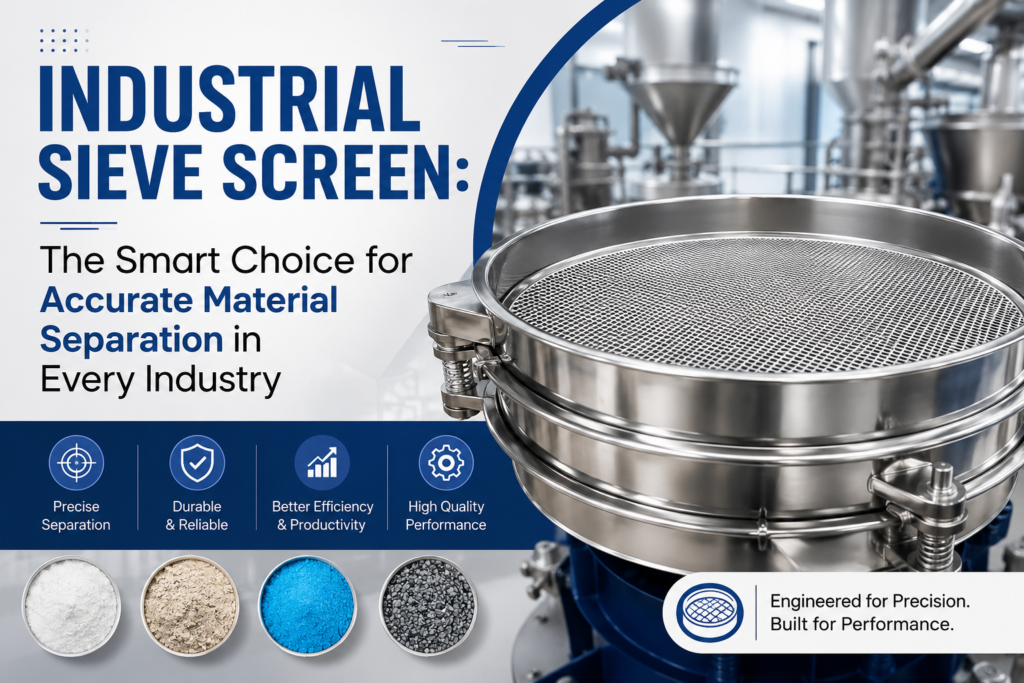
Whether you’re processing fine pharmaceutical powders, sorting food ingredients, screening chemicals, or handling minerals, one challenge remains the same—achieving consistent product quality while minimizing waste. Even the smallest impurities or oversized particles can affect production efficiency, customer satisfaction, and regulatory compliance.
This is where an industrial sieve screen becomes more than just a piece of equipment. It acts as the first quality checkpoint, ensuring only the right-sized material moves through your production line. A well-designed screen improves product consistency, protects downstream machinery, reduces downtime, and helps manufacturers meet strict quality standards.
However, choosing the right sieve isn’t always straightforward. Mesh size, material grade, durability, application, and maintenance all influence long-term performance. Many businesses focus only on price, only to discover frequent replacements, inconsistent screening, or production delays later.
This guide explores everything you need to know about sieve screens—from materials and applications to expert buying advice and common mistakes to avoid. Whether you’re upgrading an existing screening system or investing in new equipment, these practical insights will help you make a confident and informed decision.
Why an Industrial Sieve Screen Matters More Than You Think
Every manufacturing process depends on consistency. Even slight variations in particle size can affect product quality, mixing performance, packaging accuracy, and customer satisfaction.
An industrial sieve screen separates materials according to particle size using precision-engineered mesh openings. Depending on the application, it can remove contaminants, classify powders, grade granules, or improve overall product uniformity.
Industries ranging from pharmaceuticals and food processing to chemicals, ceramics, recycling, and mining rely on these screens every day.
The right screen not only improves quality but also reduces product rejection, equipment wear, and maintenance costs.
Understanding Stainless Sieve Screen Materials
Among all available materials, a stainless sieve screen remains the preferred choice for industrial applications.
Its corrosion resistance makes it ideal for environments exposed to moisture, chemicals, acids, and regular cleaning.
Why stainless steel is widely preferred
- Excellent corrosion resistance
- Long service life
- Easy to clean and sanitize
- High tensile strength
- Suitable for food and pharmaceutical industries
- Resistant to rust and oxidation
Most manufacturers use SS304 for general applications and SS316 for industries requiring higher corrosion resistance, including pharmaceutical and chemical processing.
Although stainless steel screens may have a slightly higher initial cost, they often provide better long-term value through lower replacement frequency.
Where Industrial Sieve Screens Are Commonly Used
Industrial screening plays an essential role across countless manufacturing sectors.
| Industry | Common Application |
|---|---|
| Food Processing | Flour, spices, sugar, grains |
| Pharmaceuticals | Powder classification |
| Chemicals | Pigments, fertilizers, resins |
| Minerals | Sand, silica, ores |
| Ceramics | Clay and ceramic powders |
| Recycling | Plastic granules and waste separation |
| Paint Industry | Pigment screening |
| Agriculture | Seed grading |
Each application requires a different mesh specification based on particle size, production volume, and product sensitivity.
Using the wrong screen can reduce throughput and increase product losses.
Choosing the Right Mesh Size for Better Results
Mesh size directly affects screening performance.
A finer mesh captures smaller particles but processes material more slowly.
A larger mesh allows higher production capacity while removing only oversized particles.
Factors to consider
- Particle size distribution
- Moisture content
- Production capacity
- Desired product quality
- Material flow characteristics
For example, pharmaceutical powders often require ultra-fine meshes, while fertilizer production may use larger openings for faster throughput.
Testing your material before finalizing a mesh specification can prevent expensive production issues later.
How a Quality Sieve and Screen in Vadodara Supports Industrial Growth
Vadodara has become one of India’s major industrial manufacturing hubs, serving pharmaceutical, chemical, engineering, and food processing companies.
As industries expand, the demand for high-quality sieve and screen in Vadodara continues to grow.
Local manufacturers often provide:
- Custom mesh sizes
- Faster replacement support
- Technical consultation
- Shorter delivery times
- Better after-sales service
Working with an experienced regional supplier also makes it easier to source replacement screens quickly, minimizing production downtime.
For industries operating continuous production lines, this local availability becomes a major operational advantage.
Key Features That Separate High-Quality Screens from Ordinary Ones
Not every industrial sieve delivers the same performance.
Professional manufacturers focus on precision engineering rather than simply producing mesh.
Look for features such as:
- Uniform mesh openings
- High-quality stainless steel wire
- Strong welded joints
- Accurate tensioning
- Smooth finishing
- Vibration resistance
- Long fatigue life
Poor-quality screens often fail around the edges first, causing premature replacement and production interruptions.
Investing in quality significantly reduces long-term maintenance costs.
Benefits of Using the Right Sieve Screen
Selecting the correct screen provides benefits throughout the production process.
Improved Product Quality
Consistent particle sizing improves product appearance, performance, and customer satisfaction.
Higher Production Efficiency
Proper screening minimizes bottlenecks and improves material flow.
Reduced Machine Wear
Removing oversized particles protects mixers, pumps, conveyors, and packaging equipment.
Lower Waste
Accurate separation reduces rejected products and material loss.
Better Regulatory Compliance
Food and pharmaceutical manufacturers can more easily meet hygiene and quality standards.
Longer Equipment Life
Quality screens require fewer replacements, lowering maintenance expenses.
Things Most Buyers Ignore Before Purchasing
Many purchasing decisions focus almost entirely on price.
However, experienced production managers evaluate several additional factors.
Mesh Tension
Poor tension causes inaccurate screening and premature failure.
Weld Quality
Weak welding often leads to tearing around the frame.
Material Certification
Certified stainless steel ensures long-term corrosion resistance.
Replacement Availability
Quick access to replacement screens minimizes downtime.
Application Compatibility
A screen suitable for dry powders may not perform well with sticky or moist materials.
Ignoring these details often results in higher operating costs over time.
Common Mistakes That Reduce Screening Performance
Even premium screens can perform poorly when used incorrectly.
Some common mistakes include:
- Choosing the wrong mesh size
- Overloading the machine
- Ignoring regular cleaning
- Using damaged screens
- Improper installation
- Delaying replacement after visible wear
Routine inspection helps identify small issues before they become expensive production problems.
Replacing a damaged screen early often prevents contamination and product rejection.
Expert Tips for Maximizing Screen Life
Manufacturing professionals follow several best practices to improve screen performance.
Inspect Frequently
Check mesh integrity before every production cycle.
Clean Properly
Use appropriate cleaning methods without damaging the mesh.
Avoid Excessive Loading
Operating within recommended capacity extends screen life.
Store Carefully
Unused screens should remain dry and protected from physical damage.
Keep Spare Screens Ready
Maintaining replacement inventory minimizes unexpected downtime.
These simple habits often increase service life significantly.
Buying Guide: How to Choose the Right Sieve Screen
Before making a purchase, evaluate the following criteria.
| Buying Factor | Why It Matters |
|---|---|
| Material Grade | Determines corrosion resistance |
| Mesh Size | Controls separation accuracy |
| Wire Diameter | Influences durability |
| Frame Quality | Prevents deformation |
| Industry Application | Ensures compatibility |
| Cleaning Requirements | Impacts maintenance |
| Production Capacity | Affects throughput |
| Supplier Support | Faster replacement and technical assistance |
Choosing based solely on price often leads to higher maintenance expenses later.
Instead, calculate the total cost of ownership over several years.
How Proper Maintenance Improves Long-Term Performance
Routine maintenance extends equipment life while maintaining screening accuracy.
Create a maintenance schedule that includes:
- Daily visual inspection
- Weekly cleaning
- Monthly tension checks
- Immediate replacement of damaged mesh
- Lubrication of screening equipment where applicable
Well-maintained screens deliver more consistent performance while reducing production interruptions.
Frequently Asked Questions
Q. What is an industrial sieve screen used for?
Ans: An industrial sieve screen separates materials according to particle size, removes contaminants, and improves product consistency across manufacturing processes.
Q. Why is a stainless sieve screen preferred?
Ans: Stainless steel offers excellent corrosion resistance, durability, hygiene, and long service life, making it suitable for demanding industrial applications.
Q. How do I choose the correct mesh size?
Ans: Select mesh size based on particle size, production capacity, material characteristics, and desired product quality. Material testing is recommended before finalizing specifications.
Q. How often should sieve screens be replaced?
Ans: Replacement depends on operating conditions, material abrasiveness, and maintenance practices. Regular inspection helps determine the right replacement schedule.
Q.Which industries commonly use industrial screens?
Ans: Food processing, pharmaceuticals, chemicals, mining, ceramics, agriculture, plastics, recycling, and many other manufacturing industries.
Q. Can industrial sieve be customized?
Ans: Yes. Many manufacturers offer customized mesh sizes, frame dimensions, wire diameters, and materials based on specific production requirements.
Q.How do I maintain a sieve screen?
Ans: Clean regularly, inspect for tears, avoid overloading, store properly, and replace damaged screens promptly.
Key Takeaways
✔ Industrial sieve screens improve product quality and production efficiency.
✔ Stainless sieve screens provide superior durability and corrosion resistance.
✔ Selecting the correct mesh size is essential for accurate material separation.
✔ Quality manufacturing reduces downtime and maintenance costs.
✔ Proper maintenance significantly extends screen service life.
Final Thoughts
An industrial sieve screen is much more than a filtering component—it is a vital part of maintaining product quality, protecting equipment, and improving manufacturing efficiency. The right combination of mesh size, material grade, and construction quality can make a measurable difference in production consistency and operating costs.
If you’re evaluating new screening solutions or replacing worn components, take the time to assess your application requirements instead of focusing only on the initial purchase price. A durable stainless sieve screen from a trusted supplier can deliver years of reliable performance, especially when paired with proper maintenance and regular inspections. Contact to Mech Tech Steel Industries for more informantion
No comment