
Vibratory Motor Manufacturer in India: Choosing the Right Motor for Industrial Applications
Introduction
A vibratory motor is a key component in equipment that depends on controlled vibration for screening, separation, conveying, compacting, and material handling. Selecting the right motor can directly affect machine performance, product consistency, energy use, and maintenance requirements. A reliable Vibratory Motor Manufacturer in India can help industries select suitable motor power, vibration force, mounting arrangement, and operating specifications based on the application. This is especially important for pharmaceutical, food, chemical, nutraceutical, and other powder-processing industries where dependable vibration is essential for continuous production.
AI Overview Summary
A vibratory motor is an electric motor that produces controlled mechanical vibration using eccentric weights. It is commonly used in vibro sifters, screening machines, feeders, conveyors, and material-handling equipment. The correct motor depends on machine size, load, required vibration force, speed, mounting, and operating environment.
What is a Vibratory Motor Manufacturer in India?
A Vibratory Motor Manufacturer in India designs and manufactures motors specifically intended to generate controlled vibration for industrial machinery. Unlike a standard electric motor, a vibratory motor uses eccentric or unbalanced weights to create centrifugal force when the motor shaft rotates.
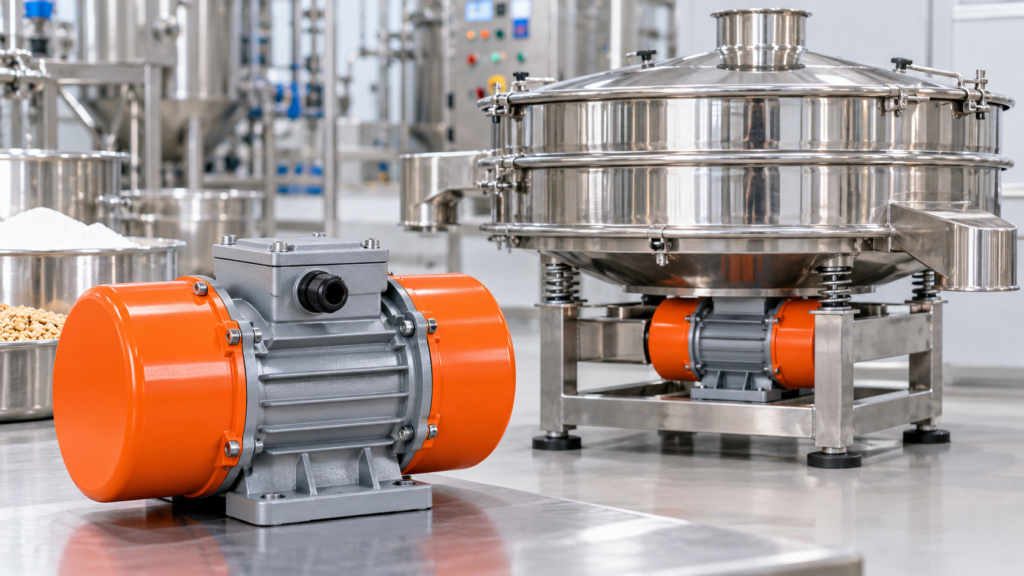
The vibration generated by the motor can be transferred to equipment such as a vibro sifter, vibrating screen, feeder, or conveyor. In a vibro sifter, for example, the motor creates multi-directional movement that helps distribute material across the mesh and separate particles according to size.
Why is it Important?
The motor is one of the most important operating components in vibration-based equipment. An incorrectly selected motor can result in insufficient screening, excessive vibration, higher noise, premature component wear, or inconsistent material flow.
For pharmaceutical and food applications, consistent screening can help maintain uniform particle size and remove unwanted lumps or oversized particles. Vibro sifters are widely used for powders and granules across pharmaceutical, food, chemical, nutraceutical, cosmetic, and related industries.
A suitable Vibratory Motor Supplier in India can also support replacement requirements when an existing motor fails or when an older vibro sifter needs a compatible replacement component.
Key Features
Important features to evaluate include:
- Eccentric Weight System: Generates the centrifugal force required for controlled vibration.
- Motor Power: Determines the motor’s ability to handle the equipment load and operating conditions.
- Adjustable Vibration: Suitable eccentric-weight arrangements can help control vibration intensity.
- Robust Construction: Helps the motor withstand continuous industrial operation.
- Suitable Mounting: Correct mounting ensures efficient transmission of vibration to the machine.
- Electrical Compatibility: Voltage, frequency, phase, and power requirements should match the installation.
- Protection Rating: The appropriate enclosure and protection level should be selected according to the operating environment.
IEC 60034-14 provides requirements related to factory acceptance vibration testing and vibration limits for certain rotating electrical machines, making vibration performance an important consideration when evaluating motor quality.
Benefits
A correctly selected vibratory motor can provide several practical advantages:
- Consistent Material Screening: Helps maintain steady movement across the screening surface.
- Improved Production Efficiency: Supports continuous material handling and separation.
- Reduced Manual Handling: Automation reduces dependence on manual sieving and material movement.
- Better Process Control: Controlled vibration can improve repeatability between batches.
- Lower Unplanned Downtime: Correct motor selection reduces the risk of application-related failures.
- Flexible Applications: Motors can be used with different vibration-based machines and process systems.
Applications
A Vibration Motor Manufacturer in India may supply motors for applications such as:
- Pharmaceutical and nutraceutical vibro sifters
- Food and spice screening machines
- Chemical powder separation systems
- Vibrating feeders and conveyors
- Industrial screening equipment
- Granule and powder classification
- Material compacting equipment
- Mineral and pigment processing
- Ceramic and plastic processing
In vibro sifters, eccentric weights generate horizontal, vertical, and circular movement, allowing material to travel across the screen and separate according to particle size.
How to Choose the Right Vibratory Motor Manufacturer in India
Before purchasing a motor, consider these practical points:
- Check Motor Power: Select the power according to the machine size, material load, and operating requirements rather than choosing only by price.
- Confirm Centrifugal Force: The required vibration force depends on the equipment design and material being processed.
- Match Electrical Specifications: Verify voltage, phase, frequency, RPM, and other electrical requirements before installation.
- Consider the Application: A pharmaceutical vibro sifter may have different requirements from a heavy-duty industrial feeder.
- Check Mounting Dimensions: Shaft, mounting arrangement, physical dimensions, and weight must be compatible with the existing equipment.
- Ask About Spare Parts and Support: For production equipment, availability of replacement components and technical assistance can reduce downtime.
Common Mistakes to Avoid
- Selecting a motor only based on horsepower.
- Ignoring the required centrifugal force.
- Installing an incompatible replacement motor.
- Failing to check mounting dimensions.
- Using unsuitable electrical specifications.
- Ignoring the operating environment.
- Choosing a supplier without checking technical support and replacement availability.
- Increasing vibration beyond the machine manufacturer’s recommended operating range.
Conclusion
A vibratory motor plays an important role in maintaining efficient and consistent operation of screening and material-handling equipment. Choosing the right Industrial Vibratory Motor Manufacturer involves more than comparing price. Power, centrifugal force, mounting, electrical specifications, application requirements, construction, and after-sales support should all be considered.
For businesses looking for a Vibratory Motor for Vibro Sifter or replacement components, discussing the machine’s technical requirements with the manufacturer can help identify a compatible solution. This approach can support reliable operation and reduce avoidable maintenance issues.
Frequently Asked Questions
What is a vibratory motor?
A vibratory motor is an electric motor designed to generate controlled mechanical vibration. It normally uses eccentric weights attached to the rotating shaft to produce centrifugal force. These motors are commonly installed on vibro sifters, vibrating screens, feeders, conveyors, and other equipment where controlled vibration is required for screening or material movement.
What are the benefits of a vibratory motor?
A vibratory motor can provide controlled and repeatable vibration for industrial processes. It can support faster screening, material separation, conveying, and feeding while reducing manual handling. In suitable applications, controlled vibration can also improve process consistency and help maintain steady material flow through screening or handling equipment.
Where are vibratory motors used?
Vibratory motors are used in pharmaceutical, nutraceutical, food processing, chemical, mineral, ceramic, plastic, and other manufacturing industries. Common applications include vibro sifters, vibrating screens, feeders, conveyors, compacting equipment, and material classification systems where controlled mechanical vibration is required.
How do I choose the right vibratory motor?
Start by checking the equipment manufacturer’s requirements, machine size, material load, required centrifugal force, motor power, RPM, voltage, phase, frequency, and mounting arrangement. The operating environment should also be considered. For replacement applications, compare the existing motor’s complete technical specifications instead of matching horsepower alone.
Is a vibratory motor customizable?
Depending on the manufacturer and application, vibratory motors may be available with different power ratings, speeds, mounting arrangements, electrical configurations, protection levels, and eccentric-weight settings. Custom requirements should be discussed with the manufacturer using the machine’s operating data and installation dimensions to determine technical compatibility.
What material is best for a vibratory motor?
The best construction depends on the application and operating environment. Industrial vibratory motors generally require durable housings and components capable of handling continuous vibration. For equipment used in hygienic industries, the motor’s placement, surrounding machine construction, cleaning requirements, and environmental protection should be evaluated together rather than selecting material based on the motor alone.
No comment