
Vibro Sifter Spare Parts: The Small Components That Can Make or Break Your Screening Process
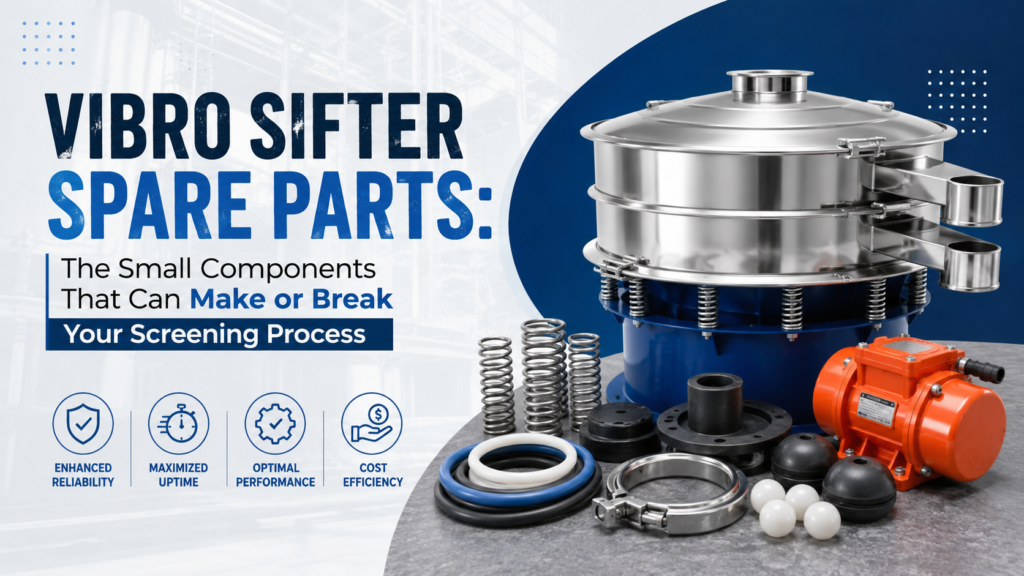
A vibro sifter can look perfectly fine from the outside and still deliver poor results.
The machine may start normally. The motor may run. Material may continue moving through the screen. Yet, somewhere along the production line, the output begins to change. Fine powder appears in the wrong fraction. Screening takes longer. The machine sounds louder than usual. Operators clean the mesh more often, but the problem keeps returning.
In many cases, the entire machine is not at fault. A worn gasket, damaged mesh, weak rubber ball, loose clamp, or tired spring may be enough to affect the whole screening process.
That is why choosing the right vibro sifter spare is not simply a maintenance task. It is part of protecting product quality, machine performance, and production consistency.
For industries handling powders, granules, chemicals, food ingredients, minerals, or pharmaceutical materials, even a small component can influence how effectively a sifter separates particles. When spare parts are ignored until failure, the result can be unexpected downtime, contamination risks, inconsistent output, and unnecessary repair costs.
The better approach is to understand which components wear first, what signs to watch for, and how to choose replacement parts that actually match the machine and application.
This guide takes a practical look at vibro sifter spare parts, from the components that matter most to the buying mistakes that often go unnoticed. Whether you operate one screening machine or manage an entire production line, a smarter spare-parts strategy can help keep your equipment working the way it should.
Why Vibro Sifter Spare Parts Matter More Than Most Operators Realize
A vibro sifter machine works through controlled vibration. That vibration moves material across a screen so particles can be separated according to size.
The process sounds simple, but the machine depends on several components working together with the right fit, tension, flexibility, and movement.
A damaged screen can affect separation accuracy. A worn gasket may allow leakage. A weak spring can change the vibration pattern. A deteriorated rubber ball may reduce mesh cleaning efficiency.
The machine is therefore only as reliable as the parts supporting its operation.
Imagine a food-processing unit screening spice powder. The motor is working properly, but the mesh has developed a small tear. The damage may not stop production immediately. Instead, oversized particles slowly begin passing into the finished product.
The problem may only become visible during quality inspection—or worse, after packaging.
This is why experienced maintenance teams do not wait for a complete breakdown. They inspect critical components regularly and replace worn parts before they begin affecting output.
Key takeaway: A spare part may be inexpensive compared with the machine itself, but its effect on production quality can be significant
Understanding How a Vibro Sifter Machine Works
Before choosing replacement parts, it helps to understand what happens inside the machine.
A typical vibro sifter machine uses a vibration motor to create controlled movement. Material is fed onto a screening surface, where vibration helps particles travel across the mesh.
Smaller particles pass through the screen openings, while larger particles remain above and move toward a separate outlet.
Depending on the machine design, several decks may be used to separate material into multiple particle sizes.
The screening process depends on a balance between:
- Vibration intensity
- Mesh size and condition
- Material flow
- Screen tension
- Machine alignment
- Cleaning efficiency
- Seal integrity
If one part changes, the balance can change with it.
For example, increasing vibration will not necessarily solve poor screening if the mesh is blocked. Replacing a motor will not fix leakage caused by a damaged gasket. Tightening a loose clamp repeatedly will not help if the clamp itself has lost its holding strength.
Good maintenance begins with identifying the actual source of the problem rather than replacing the most obvious component.
The Most Important Vibro Sifter Spare Parts to Keep in Stock
Not every component wears at the same rate. Some parts are exposed to constant vibration, friction, material contact, or repeated cleaning and therefore require more frequent attention.
Screen Mesh
The screen mesh is one of the most important working components in a sifter.
It determines which particles pass through and which remain above the screening surface. A damaged, incorrectly tensioned, or unsuitable mesh can directly affect separation quality.
Common warning signs include:
- Visible tears or broken wires
- Frequent clogging
- Reduced screening capacity
- Incorrect particle separation
- Uneven material movement
When ordering a replacement mesh, do not rely only on the mesh number. Wire diameter, aperture size, material grade, screen diameter, and tensioning method can all affect performance.
A mesh that technically “fits” the machine may still perform poorly if it is not suitable for the product.
Rubber Balls
Rubber balls are often positioned beneath the screen as part of a mesh-cleaning arrangement.
As the machine vibrates, the balls bounce against the underside of the mesh. This action helps dislodge particles that may otherwise block the openings.
Over time, rubber balls can become:
- Hard
- Flat
- Cracked
- Worn
- Less elastic
When that happens, mesh cleaning becomes less effective.
A common mistake is to keep cleaning a blocked screen while ignoring the worn balls underneath it.
Gaskets and Seals
Gaskets help create a secure seal between different machine sections.
They can help reduce:
- Material leakage
- Dust escape
- Cross-contamination
- Unwanted movement between machine sections
The correct gasket material depends heavily on the application.
Food, pharmaceutical, chemical, and high-temperature processes may require different elastomers. A low-cost gasket made from the wrong material can deteriorate quickly or become unsuitable for the product being processed.
Clamps
Clamps may appear simple, but they help hold machine sections together securely.
A damaged or poorly fitted clamp can create movement, noise, leakage, or alignment problems.
Repeatedly tightening an old clamp is not always the answer. If it has lost shape or holding force, replacement may be the safer choice.
Springs
Springs help support the vibrating assembly and influence machine movement.
A weak, damaged, or uneven spring can affect vibration distribution. In some cases, the machine may still operate while producing excessive noise or unstable movement.
Springs should generally be inspected as a set rather than individually.
Vibration Motor Components
The vibration motor is central to machine movement, but motor-related problems should be diagnosed carefully.
Unusual noise or reduced performance may come from the motor, but it may also be caused by loose mounting, damaged springs, incorrect weight settings, or structural issues.
Before replacing an expensive component, inspect the complete vibration system.
How One Worn Vibro Sifter Spare Can Affect the Entire Process
One of the biggest maintenance mistakes is assuming that a small component can only create a small problem.
In screening equipment, that is rarely true.
Suppose a gasket begins to wear. At first, there may only be a small amount of dust around the machine. The operator wipes it away and production continues.
Over time, the leakage increases. Product is lost. The surrounding area becomes harder to keep clean. If the material is sensitive, hygiene or contamination concerns may also develop.
Now consider a worn mesh-cleaning ball.
The screen gradually begins to blind. Effective screening area decreases. Throughput falls. Operators may increase feed rates or adjust vibration in an attempt to compensate.
The original problem was a small worn component, but the response may create additional stress on the machine.
This is why maintenance teams should look at cause and effect, not just the visible symptom.
A Useful Troubleshooting Principle
When performance changes, ask three questions:
- What changed in the final product?
- What changed in the machine’s sound or movement?
- Which wear component could create both symptoms?
This simple approach can prevent unnecessary part replacement.
How to Choose the Right Vibro Sifter Spare Parts
Buying replacement components should not begin with price.
The first question should be: Will this part perform correctly in my machine and process?
Two spare parts can look almost identical and still behave differently under vibration, heat, chemical exposure, or continuous production.
Check the Exact Machine Specifications
Before requesting a replacement, collect accurate machine details.
Useful information may include:
- Machine diameter
- Model or design
- Number of decks
- Existing part dimensions
- Mesh specification
- Material being screened
- Operating temperature
- Contact-material requirements
- Production environment
Photographs can help, but dimensions and specifications are more reliable.
Consider the Material Being Processed
A machine screening flour does not face the same conditions as one screening abrasive minerals or reactive chemicals.
Ask how the material behaves.
Is it sticky?
Is it abrasive?
Does it generate heat?
Is it oily?
Does it require hygienic contact surfaces?
Does it react with certain rubber materials?
The correct vibro sifter spare parts should be selected for the process, not only for the machine.
Confirm Material Compatibility
This is particularly important for gaskets, rubber components, mesh, and contact parts.
Stainless steel grade, rubber type, temperature resistance, and chemical compatibility can all matter.
For regulated industries, documentation and material traceability may also be important.
Avoid Choosing by Appearance Alone
A spare part can look correct in a photograph and still have the wrong dimensions, material, hardness, or construction.
This is one of the most common causes of premature replacement failure.
Expert tip: When replacing a part that has performed well for a long time, record its complete specification before disposal. That information can make future procurement much easier.
Buying Guide: What to Check Before Ordering a Vibro Sifter Spare
A good buying process reduces trial-and-error replacements.
Before placing an order, create a simple technical checklist.
| Component | What to Check | Why It Matters |
|---|---|---|
| Screen mesh | Aperture, wire diameter, material, size | Affects separation accuracy and life |
| Gasket | Profile, dimensions, elastomer | Affects sealing and compatibility |
| Rubber ball | Size, material, hardness | Influences mesh cleaning |
| Clamp | Diameter, design, locking condition | Helps secure machine sections |
| Spring | Size, load characteristics, matching set | Affects vibration stability |
| Motor-related part | Model and technical specification | Helps maintain correct vibration |
Price should be considered after compatibility and expected service life.
A cheaper component that requires frequent replacement may cost more over a year than a better-quality part with a longer working life.
Also consider availability.
If a critical spare has a long lead time, keeping one in inventory may be more economical than waiting for an emergency breakdown.
For frequently used machines, spare-parts planning should be based on failure impact, not just purchase cost.
Things Most Buyers Ignore When Purchasing Vibro Sifter Spare Parts
The Cost of Downtime
Buyers often compare two spare parts based only on unit price.
But if the cheaper option fails during a busy production schedule, the real cost may include lost output, operator time, cleaning, rejected material, and delayed orders.
The purchase price is only one part of the calculation.
The Condition of Related Components
Replacing one worn part without checking connected components can shorten the life of the new replacement.
For example, installing a new screen while ignoring damaged supports or incorrect tension may lead to another early failure.
Similarly, replacing one spring when the remaining springs are heavily worn can create uneven performance.
Storage Conditions
Spare parts can deteriorate before they are installed.
Rubber components should not be stored carelessly near excessive heat, direct sunlight, oils, or harsh chemicals.
Meshes should be protected from bending and physical damage.
A spare part is only useful if it remains in good condition until needed.
Cleaning Compatibility
Industrial components may be exposed to repeated washing, sanitizing, steam, solvents, or aggressive cleaning agents.
A material that performs well during production may still fail early if it cannot tolerate the cleaning process.
Always consider both operating conditions and cleaning conditions.
Common Mistakes That Reduce Vibro Sifter Machine Performance
Waiting for Complete Failure
This is the most expensive maintenance habit.
A worn component often gives warning signs before it fails completely. Noise, leakage, lower throughput, unusual vibration, and repeated mesh blockage should not be ignored.
Using the Wrong Mesh
Choosing a mesh only by “mesh number” can lead to mistakes.
Screen performance can also depend on aperture, wire thickness, weave, material, and tension.
Over-Tightening Components
More force does not always create a better seal or a more secure machine.
Over-tightening can damage clamps, deform gaskets, or create unnecessary stress.
Replacing Parts Without Finding the Root Cause
If a screen fails repeatedly in the same area, the screen itself may not be the main problem.
Possible causes can include:
- Incorrect tension
- Excessive vibration
- Poor installation
- Abrasive product
- Damaged support structure
- Uneven loading
Repeated failure is a signal to investigate the system.
Buying Generic Parts Without Verifying Fit
“Suitable for vibro sifter” is not a complete specification.
Always confirm dimensions and operating requirements before purchasing.
Expert Tips for Extending the Life of Vibro Sifter Spare Parts
A strong maintenance routine does not need to be complicated.
The goal is to notice gradual changes before they become production problems.
Inspect by Condition, Not Only by Calendar
A monthly inspection schedule is useful, but operating conditions matter more than the date.
A machine running continuously with abrasive material may require more frequent inspection than one used occasionally for a light powder.
Keep a Simple Maintenance Record
Record:
- Installation date
- Replacement date
- Reason for replacement
- Observed wear
- Supplier specification
- Machine operating hours, where available
After several replacement cycles, patterns often become visible.
You may discover that a particular gasket fails after a certain cleaning process or that screens break more frequently after a production change.
Listen to the Machine
Operators who work around the same equipment every day often notice changes before instruments do.
A new rattling sound, uneven movement, or unusual vibration should be investigated early.
Replace Matched Components Carefully
Some components, particularly springs, may perform better when replaced as a matched set.
Mixing heavily worn and new components can sometimes create uneven movement.
Keep Critical Spares Ready
Not every spare part needs to sit on a shelf.
However, parts that are inexpensive, frequently replaced, or capable of stopping production should usually be available when the machine is critical to operations.
When Should You Repair a Part and When Should You Replace It?
Repair is not always the most economical choice.
A component should generally be replaced when its structural integrity, sealing ability, material condition, or performance can no longer be trusted.
A damaged mesh, cracked gasket, heavily worn rubber ball, distorted clamp, or fatigued spring should not remain in service simply because the machine can still run.
Temporary fixes may be useful in some non-critical situations, but they should not become permanent maintenance strategies.
Ask:
Can the repaired component perform as reliably as the original?
Could failure affect product quality or safety?
Will the repair cost nearly as much as replacement?
Could continued use damage another component?
If the risk of continued use is greater than the cost of replacement, replacing the part is usually the better decision.
Choosing Vibro Sifter Manufacturers in Vadodara for Spare-Part Support
When evaluating Vibro Sifter Manufacturers in Vadodara, buyers often focus on the machine itself. Spare-part support deserves equal attention.
A screening machine may operate for years, but wear components will eventually require replacement.
Before choosing a manufacturer or spare-parts supplier, ask practical questions.
Can they help identify the correct part from machine specifications?
Do they understand different industrial applications?
Can they provide suitable materials for the product being screened?
Are common wear parts available without excessive delays?
Can they support older machine configurations?
A knowledgeable supplier should ask about the application before recommending a component.
For example, a gasket recommendation should consider temperature, product contact, cleaning methods, and chemical exposure. A mesh recommendation should consider particle size, material behaviour, throughput, and screening objective.
That level of technical discussion is usually more valuable than simply receiving the lowest quotation.
For businesses sourcing from industrial manufacturing hubs such as Vadodara, supplier capability should be judged on technical understanding, consistency, compatibility, and support.
Building a Smarter Spare-Parts Inventory
Keeping every possible spare part in stock is expensive and unnecessary.
Keeping no critical spares is equally risky.
A better approach is to classify parts according to operational impact.
Critical Spares
These are components that can stop production or seriously affect product quality.
Examples may include essential screen assemblies, specific gaskets, springs, or critical motor-related components.
Frequently Replaced Wear Parts
These parts may have a predictable replacement cycle.
Rubber balls, seals, meshes, and similar wear components often fall into this category.
Non-Critical Parts
These can usually be ordered when needed without creating major production risk.
The right inventory level depends on machine usage, supplier lead time, production schedules, and the cost of downtime.
A useful rule is simple: The harder a part is to obtain and the greater the damage caused by its absence, the stronger the case for keeping it in stock.
How Preventive Maintenance Protects Screening Quality
Preventive maintenance is often discussed as a way to avoid breakdowns, but its effect on product quality is just as important.
A machine does not need to stop completely to perform poorly.
A partially blocked screen can reduce capacity.
A damaged mesh can affect particle separation.
A worn seal can allow leakage.
Uneven vibration can change material movement.
These problems may develop gradually, making them easy to miss.
A practical inspection routine should include:
- Checking screen condition
- Inspecting gaskets for wear or deformation
- Examining clamps and connections
- Looking for unusual material leakage
- Checking rubber balls or other cleaning systems
- Observing machine movement
- Listening for unusual noise
- Checking springs for visible damage
The aim is not to replace parts unnecessarily. It is to replace them at the right time.
Frequently Asked Questions
Q. What are the most commonly replaced vibro sifter spare parts?
Ans: Common replacement parts include screen mesh, gaskets, rubber balls, clamps, springs, and selected vibration-system components. Replacement frequency depends on machine usage, material characteristics, and operating conditions.
Q. How do I know when a vibro sifter spare needs replacement?
Ans: Watch for signs such as reduced screening efficiency, leakage, excessive noise, unusual vibration, repeated mesh blockage, visible wear, or inconsistent product quality.
Q. Can I use generic spare parts in a vibro sifter machine?
Ans: Only if the part matches the required dimensions, material, design, and operating conditions. A component that looks similar may not perform correctly under vibration or product-contact conditions.
Q. How often should vibro sifter machine parts be inspected?
Ans: Inspection frequency should depend on operating hours, material abrasiveness, cleaning frequency, and the importance of the machine to production. High-use machines should generally be checked more often.
Q. Why does a vibro sifter screen keep breaking?
Ans: Repeated screen failure can be caused by incorrect tension, excessive vibration, poor installation, abrasive material, damaged supports, or unsuitable mesh specifications. Replacing the screen without finding the root cause may lead to repeated failure.
Q. What information should I provide when ordering a replacement spare?
Ans: Provide the machine model or diameter, component dimensions, material requirements, photographs where useful, operating conditions, and details of the product being processed.
Q. Should all springs be replaced together?
Ans: If springs have experienced similar operating hours and wear, replacing them as a matched set may help maintain more balanced machine movement. The actual decision should be based on machine design and component condition.
Q. Why is supplier support important when buying vibro sifter spare parts?
Ans: Technical support can help prevent incorrect part selection. A knowledgeable supplier can consider machine compatibility, material behaviour, operating temperature, hygiene requirements, and other process conditions before recommending a replacement.
Final Thoughts
A vibro sifter is a system of components working together.
The motor may create the vibration, but reliable screening also depends on the condition of the mesh, seals, springs, clamps, cleaning elements, and other wear parts.
That is why a vibro sifter spare should never be selected as an afterthought.
The right replacement part can help restore screening efficiency, reduce unexpected downtime, protect product consistency, and extend the useful life of the machine. The wrong one may fit physically but create repeated maintenance problems.
The most effective approach is simple: understand the machine, understand the material being processed, inspect wear components regularly, and choose replacements based on technical compatibility rather than price alone.
For production teams that rely on screening equipment every day, a well-planned spare-parts strategy can turn maintenance from an emergency response into a predictable part of operations.
If you are reviewing your current screening setup, explore related guides on vibro sifter machine maintenance, screen mesh selection, rubber components, gaskets, and preventive maintenance to build a more reliable screening process.
Contact Mech Tech Steel Industries for more information.
.
No comment